
How to Write a Japanese Receipt (領収書)
This guide focuses on how to fill out a Japanese receipt in practice. Start from the full sample, then use the numbered breakdown to see what belongs in each block and what to check for electronic delivery, the invoice system, and revenue stamps.
When a Receipt Is Used
What a receipt proves
A receipt records that payment has actually been received. In Japanese business practice, it is used for accounting, expense reimbursement, bookkeeping, and tax support, so the useful question is not whether the layout looks formal enough, but whether the document clearly shows who paid whom, for what, when, and how much.
When to issue it
A receipt is issued after payment is completed. Cash received, bank transfer confirmed, or card payment settled are typical trigger points. This is the core difference from an invoice: an invoice asks for payment before settlement, while a receipt records completion after settlement.
Read a Japanese Receipt from One Sample
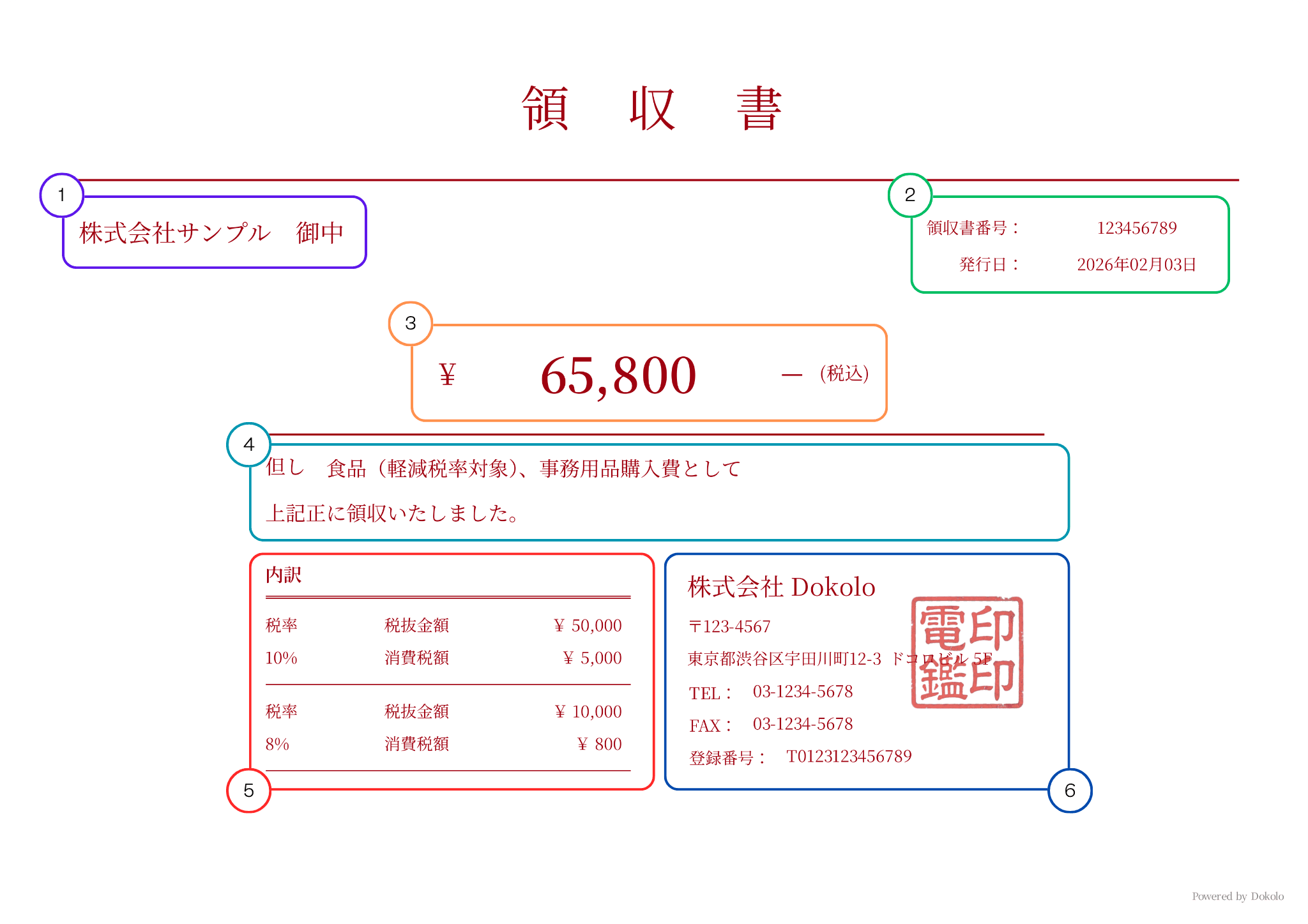
This sample splits a standard Japanese receipt into six blocks that operators usually need to check before issuing it.
What to Enter in Each Numbered Area
The sections below explain what belongs in each numbered area of the sample. Once you understand the role of each block, it becomes much easier to build a receipt without missing the standard elements.
Recipient (宛名)
Enter the company name or individual name receiving the receipt. For a company or organization, it is standard to add "御中." For an individual, add "様." If needed, you can also include the department name or the name of the person in charge on the same line. Examples: ・株式会社Dokolo 御中 ・株式会社Dokolo 経理部 御中 ・株式会社Dokolo 経理部 山田 太郎 様 ・山田 太郎 様 In simplified invoices used in sectors such as retail, the recipient name may be omitted. For ordinary B2B transactions, however, it is safer to state it clearly so the counterparty can process the document without confusion.
Receipt number and issue date
The receipt number is an internal control number. Setting a sequential number or transaction management number makes reissuance, search, and reconciliation easier. As a general rule, the issue date should be based on the date the payment was actually received. However, in cases such as credit card payments, some businesses use the transaction date or settlement date as the reference.
Received amount
Enter the actual total amount received, including tax. The amount shown on the receipt should exactly match the final amount that the other party actually paid. In Dokolo, entering the breakdown by tax rate automatically calculates the consumption tax amount and the tax-inclusive total. If you do not use the breakdown, you can enter the total amount directly.
Description (但し書き)
State clearly and specifically what the payment was for. Examples: • For book purchases (書籍代として) • For seminar participation fees (セミナー参加費として) • For accommodation charges (宿泊代として) • For office supplies purchases (事務用品購入費として) The description is an important item because it proves what the payment relates to. If the wording is too vague, such as a generic label like "merchandise," the transaction details may not be identifiable. That can create risk when the document is used as an invoice and may also affect input tax credit treatment. A receipt with an unclear description can also require additional explanation during expense review or a tax audit, and in some cases may raise suspicion about whether the expense was legitimate. If multiple goods or services are involved, you can state the representative item and add a note such as "plus XX other items." The important point is to leave the document in a state where a third party can still understand the purpose of the payment.
Tax breakdown by rate
To comply with the invoice system, you need to state the amount classified by tax rate and the consumption tax amount for each rate. If the standard rate (10%) and the reduced rate (8%) are mixed, the amounts subject to each rate should be shown separately so the applicable rate is clear. The amount by tax rate may be stated either on a tax-inclusive basis or a tax-exclusive basis. If reduced-rate items are included, the receipt should also make it clear from the transaction details which items are subject to the 8% rate. In practice, it is often clearer to add a note such as "※Reduced tax rate applies(軽減税率対象)" in the description field(但し書き).
Issuer details and seal image
The issuer's name must be stated. If the receipt is intended to comply with Japan's invoice system, the 13-digit registration number starting with "T" must also be included. The address, postal code, phone number, fax number, and email address are not legally required items, but they are commonly included for inquiry handling and document management. A seal impression, such as a company seal, is commonly used by practice, but it is not a legal requirement.
Electronic Delivery, Invoice Rules, and Revenue Stamps
Electronic receipts can be used in normal operations
In Japan, issuing receipts through PDF attachments or download links is already common practice. Guidance from Japan's National Tax Agency also explains the invoice system on the premise that invoices may be delivered not only on paper but also as electronic data. However, electronic delivery assumes that the counterparty agrees to receive the document electronically. If the recipient does not object, issuing the receipt as a PDF is generally workable in practice.
Notes when using it as an invoice
Conventional invoices and receipts can also be used as qualified invoices if they include the required items. In practice, you should check whether the following information is stated. ・ issuer name ・ registration number ・ transaction date ・ transaction details ・ consideration amount classified by tax rate ・ applicable tax rate ・ consumption tax amount by tax rate ・ name of the business receiving the document Some industries are allowed to use simplified invoices, but for ordinary B2B transactions, it is safer to include the registration number and a breakdown by tax rate.
Start the revenue-stamp decision from paper vs electronic
To decide whether a receipt needs a revenue stamp, first distinguish between "electronic delivery" and "paper delivery." Receipts delivered as electronic data, such as PDFs or email attachments, are outside the scope of stamp tax, so a revenue stamp is not required. By contrast, a paper receipt may qualify as a taxable document, so you need to check the following points. ・ whether the receipt qualifies as a taxable document for stamp-tax purposes ・ whether the stated amount is JPY 50,000 or more For a standard receipt, an amount below JPY 50,000 is non-taxable, while an amount of JPY 50,000 or more requires a revenue stamp. This standard is based on guidance from Japan's National Tax Agency. If you issue a receipt on paper, make sure to confirm whether it falls within stamp-tax scope before handing it over.
Final Checks Before Issuing
- 1Confirm that the recipient, amount, and issue date match the actual transaction details. As a general rule, the issue date should be based on the date payment was received, although in some cases, such as credit card payments, the transaction date or settlement date may be used instead.
- 2Check that the description is specific enough for expense review. Another person should be able to tell what was paid for without extra explanation.
- 3If 8% and 10% are mixed, confirm that the taxable base and tax amount are split by rate.
- 4Decide first whether you are delivering paper or electronic data. If you will issue paper, finish the revenue-stamp judgment before handing over the original.
Conclusion
Summary
A workable Japanese receipt has a clear recipient, the correct payment date, the actual received amount, a concrete description, and issuer information. Add the tax breakdown and registration number when invoice-system handling matters. Then finish by checking whether you are issuing the receipt electronically or on paper, because that affects the revenue-stamp judgment.
Disclaimer
This content is provided for general informational purposes only and is based on publicly available explanations. It does not constitute legal, tax, or accounting advice. For advice specific to your situation, please consult a qualified professional.
Ready to create your receipt?
Create professional Japanese-style receipts with simple inputs. No sign-up required, free to use.