

How to Write an Invoice in Japan (請求書): A Numbered Sample and the Qualified Invoice Rules
How to write an invoice in Japan (請求書, seikyūsho), explained with a numbered sample and a close-up of the line-item table. Also covers what a qualified invoice must contain and how to round consumption tax.
- Last verified
- 25 sources
- 14 min read
Who this is forSole proprietors and companies that send invoices to clients in Japan, whether you live in Japan or outside it (for example, in Korea).
Short answer
- A typical Japanese invoice has seven blocks: addressee, invoice number and date, subject and amount billed, issuer and registration number (登録番号), line items, bank details (振込先), and notes (備考).
- To issue a qualified invoice (適格請求書), you must show your name and registration number, the transaction date, what was supplied, the consideration totaled by tax rate with the rate applied, the consumption tax for each rate, and the name of the business receiving the invoice[1].
- On a qualified invoice, round consumption tax to the yen once per tax rate on each invoice. Rounding the tax on each line and adding up the results is not allowed[2].
- Three fields, consumption tax, registration number and withholding tax (源泉徴収), work differently depending on whether you live in Japan or outside it. Each of those fields below is split by where you live.
On this pageWhat a Japanese invoice is for, and when to send it
What a Japanese invoice is for, and when to send it
An invoice (請求書) asks the client to pay for goods or services you have already provided. A receipt (領収書) is different: it proves that payment was received[3].
Under Japan's invoice system (インボイス制度), a buyer who wants to claim an input tax credit (仕入税額控除) for consumption tax must keep books and qualified invoices that contain specific details. Only a qualified invoice issuer (適格請求書発行事業者) registered with the tax office can issue a qualified invoice[4]. The system as a whole is explained in Japan’s qualified invoice system.
Send it on the schedule you agreed with the client, such as after delivery and acceptance or on the monthly closing date (締め日). Work back from the payment due date so the client has time to process it.
How to write an invoice in Japan: the numbered sample
The sample below is an invoice made with Dokolo, divided into seven numbered blocks. The subsections follow the numbers.
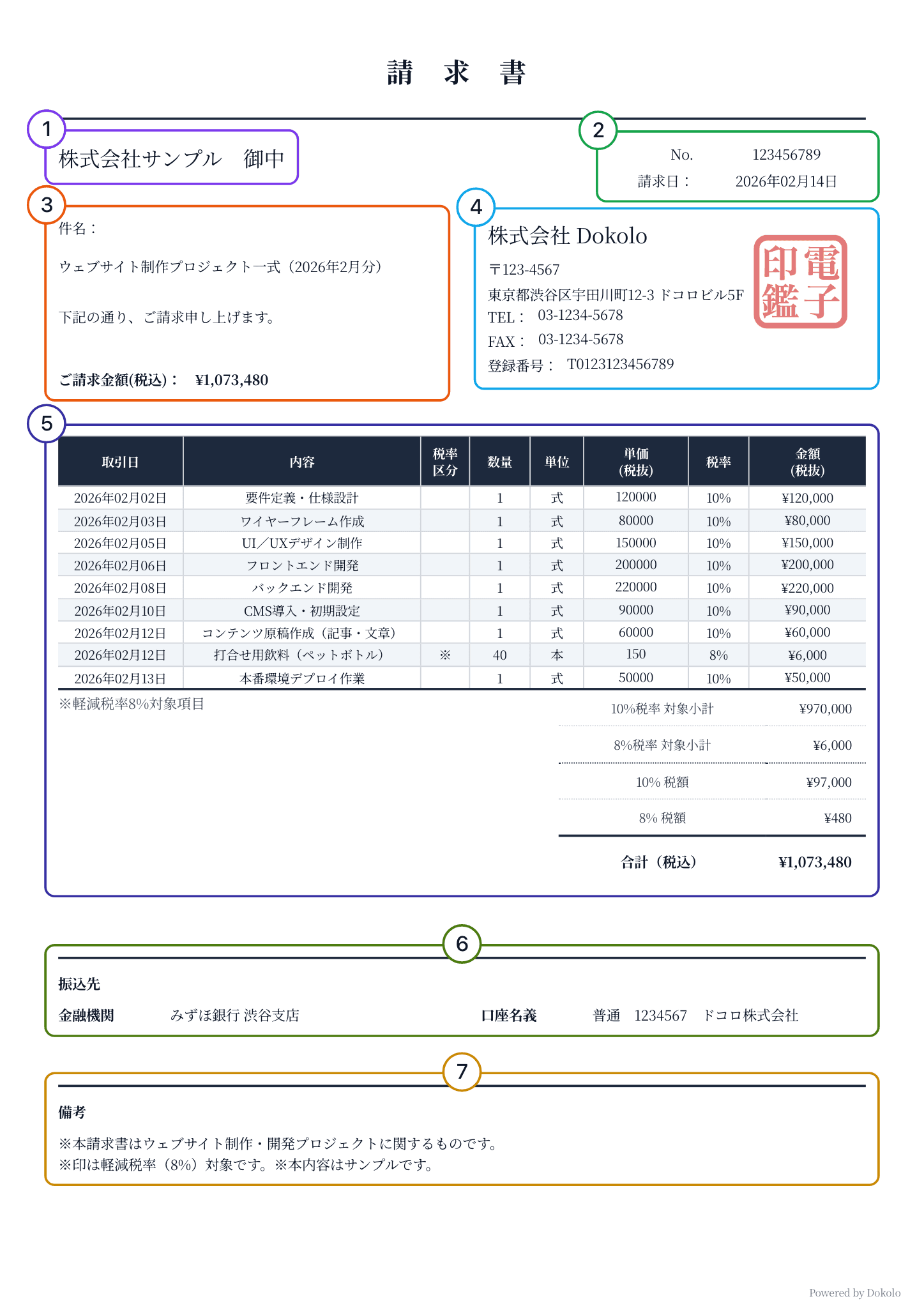
1. Addressee (宛名)
Write the client's company name or personal name. On a qualified invoice, the name of the business receiving the document is one of the required items[1].
Add 御中 (onchū) after a company or department name and 様 (sama) after a person's name. By convention, an addressee carries only one of the two, never both[5].
- 株式会社サンプル 御中 (a company)
- 株式会社サンプル 経理部 御中 (a department)
- 株式会社サンプル 経理部 山田 太郎 様 (a named contact)
- 山田 太郎 様 (an individual)
2. Invoice number and invoice date
The invoice number is your own reference for finding the invoice and matching payments with the client. Use a running number or a project number. It is not one of the qualified invoice requirements[1].
The invoice date (請求日) is the day you issue the invoice. The required "transaction date" (取引年月日) is the day the transaction took place, which is a separate thing[1]. The sample puts it in the 取引日 column of the line-item table (block 5). You may also list a month's worth of transactions on one invoice[1].
If you state a payment due date (支払期限), put it under the invoice date where the client will see it.
3. Subject (件名) and amount billed
Use the subject line for the project name or billing period so the client can tell at a glance what the invoice is for. The amount billed (ご請求金額) below it must equal the tax-inclusive total of the line-item table in block 5.
4. Issuer and registration number
Write your name or business name, and add your registration number (登録番号) if you are registered. Together they make up the first required item of a qualified invoice[1]. A business with a Japanese corporate number uses "T + corporate number"; any other business uses "T + 13 digits"[4]. Where to apply and how to check a number on the public site are covered in Japan’s qualified invoice system.
Your address, phone, fax and seal impression are not required items[1]. Listing an address and phone number as contact details is common practice[6].
If you live in Japan
Only registered qualified invoice issuers have a registration number. Once registered, you are not exempt from consumption tax even if your taxable sales in the base period (基準期間) are ¥10 million or less[4]. A client using the general method (一般課税) who receives an invoice without a registration number can, under the transitional measure, credit only 70% of the tax from October 1, 2026 to September 30, 2028[7]. Both the transitional measure and the 20% and 30% special rules (2割特例・3割特例) are explained in Japan’s 20% and 30% special rules and the transitional measure.
If you live outside Japan (e.g. Korea)
If all your sales are transactions outside Japan (国外取引, outside the scope of Japanese consumption tax), such as custom work performed in Korea, you have no obligation to issue qualified invoices[8]. A client’s input tax credit covers taxable purchases made in Japan and certain other items, not transactions outside Japan, so registering gives the client no benefit[9]. Registering removes the consumption tax exemption whatever your sales, so you may have to file and pay Japanese consumption tax[4].
5. Line items
This block lists each transaction with its date, description, quantity, unit price, tax rate and amount, then the subtotal and tax for each rate and the total. The next section goes through it column by column.
6. Bank details (振込先)
Give the bank and branch name, account type, account number and account holder. Bank details are not a qualified invoice requirement[1], but a wrong account delays payment, so check them against your bank records before sending.
If you are paid into an account outside Japan, Japanese banks ask the sender for the receiving bank's SWIFT code (BIC), the payee's full name, the payee's actual address including country and city, and the account number[10]. Writing these in English lets the client copy them straight into the transfer request.
7. Notes (備考)
Use notes for anything that does not fit elsewhere: payment terms, who pays the transfer fee, the billing period, and what the reduced-rate mark (※) means.
Filling in the line-item table
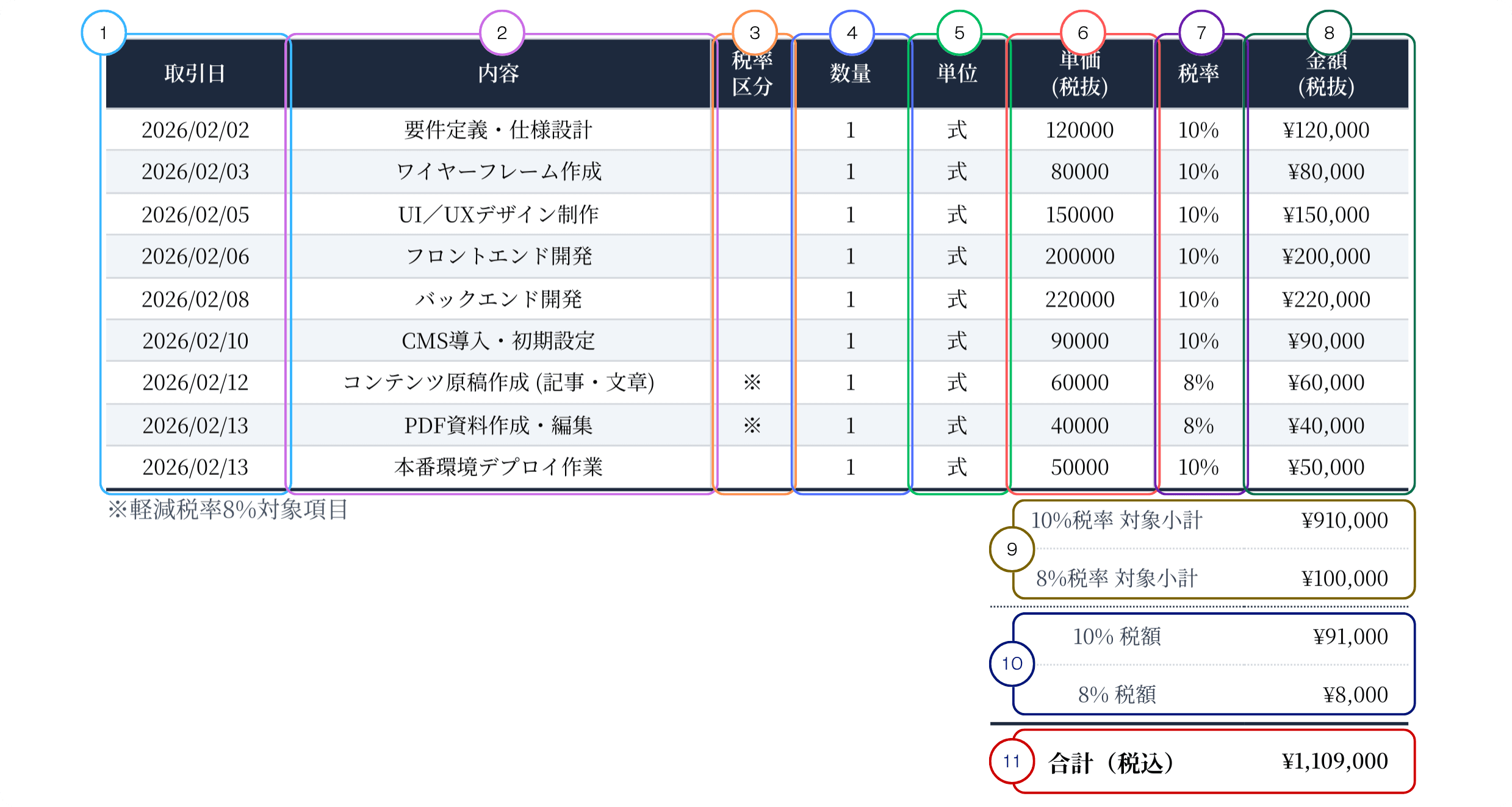
The line-item table is the basis for what you charge. Use the numbers in the close-up below to check each column.
| No. | Column | What to write |
|---|---|---|
| 1 | 取引日 (date) | The day of the transaction, such as the work or delivery date. This is the required transaction date[1]. |
| 2 | 内容 (description) | The item or work done; the required "description of the transaction"[1]. Be specific enough that a third party could tell what it was. |
| 3 | 税率区分 (tax category) | Mark reduced-rate (8%) lines with a symbol such as ※ and explain the symbol under the table[1]. |
| 4 | 数量 (quantity) | Count, hours, months and so on. Use 1 for a fixed-price job. |
| 5 | 単位 (unit) | The unit of the quantity, such as 式 (lot), 件 (item), 時間 (hour) or 月 (month). |
| 6 | 単価 (unit price, before tax) | Price per unit. The sample uses pre-tax prices; if you use tax-inclusive prices, use them for every line. |
| 7 | 税率 (tax rate) | 10% or 8%. |
| 8 | 金額 (amount, before tax) | Quantity × unit price. |
Items 9 to 11: subtotal, tax and total by rate
Item 9 is the consideration totaled for each tax rate; item 10 is the consumption tax for each rate. A qualified invoice must show both, together with the rate applied. The consideration can be stated either before tax or including tax[1].
On a qualified invoice, round consumption tax to the yen once per tax rate on each invoice. You may round down, round up or round to the nearest yen. What you may not do is calculate and round the tax on each line and then add the results[2].
Item 11, the tax-inclusive total, is 9 plus 10. Check that it matches the amount billed in block 3.
Reduced rate and the consumption tax fields
The reduced 8% rate (as of October 2026) covers food and beverages (excluding alcoholic beverages and dining out) and newspapers published at least twice a week and sold by subscription[11]. In the sample, the bottled drinks for meetings (打合せ用飲料) are food and beverages, so that line is at 8% and marked ※. Writing and development work is not a reduced-rate item, so it is at the standard 10% rate[11].
A government plan approved by the Cabinet on September 15, 2026 would lower the consumption tax rate on food and beverages to 1% (national and local combined) for two years, from April 1, 2027 to March 31, 2029. It takes effect only if the bill passes, and as of October 22, 2026 it has not[12].
If you live in Japan
If you issue a qualified invoice, show the tax rate (column 7), the consideration for each rate (item 9) and the consumption tax for each rate (item 10)[1]. If you are not registered, see the box under "4. Issuer and registration number".
If you live outside Japan (e.g. Korea)
Custom work such as design or software development done in Korea and delivered online is in most cases a transaction outside Japan, so no Japanese consumption tax is added[13][14]. Ongoing online consulting, online courses, SaaS and other "electronic services" (電気通信利用役務), and work done on site in Japan, are treated differently[13].
Showing withholding tax on the invoice
Withholding tax (源泉徴収) is income tax that the payer, your client, deducts from your fee and pays to the government; the obligation is the payer's[15][16]. Showing it on the invoice is a practical way to agree in advance on how much is deducted and how much will arrive.
If you show it, the usual approach is to add a withholding line (源泉徴収税額) and also show the amount actually paid after the deduction[17]. By convention, the withholding amount goes under the tax-inclusive total, with the net amount to be paid (差引ご請求金額) below it.
If you live in Japan
A client who is a withholding agent, such as a company or a sole proprietor with employees on payroll, withholds 10.21% from fees paid to an individual for writing, design, lectures and similar work (20.42% on the part of a single payment above ¥1,000,000)[15][18]. There is generally no withholding when the payer is an individual with no payroll withholding duty, or when the fee goes to a corporation[19][20]. Withholding tax on invoices in Japan covers which fees are withheld, consumption tax and a worked example.
If you live outside Japan (e.g. Korea)
A fee purely for work done in Korea has no Japanese withholding[21]. If it includes a copyright license or a transfer (buyout) of rights, it is a royalty: 20.42%, or 10% if the beneficial owner is a resident of Korea and the "Application Form for Income Tax Convention" (租税条約に関する届出書) was filed through the client by the day before the first payment[16][22][23][24]. The 10.21% rate does not apply[16].
Checks before you send
- Addressee, invoice date, invoice number and subject match the actual transaction.
- Quantity × unit price, the subtotal and tax for each rate, the total, and the amount billed at the top all agree.
- For a qualified invoice: registration number, transaction date, description, consideration and rate for each rate, consumption tax, and addressee are all there[1].
- Bank details, the due date and who pays the transfer fee are stated.
- The consumption tax, registration number and withholding fields follow the box above that applies to you.
If you find a mistake after sending, see Correcting or reissuing a Japanese invoice for corrected invoices and reissues.
FAQ
Is an invoice without an invoice number still a qualified invoice?
Yes, as long as it has all the required items. The invoice number is not one of them[1]. Most businesses still number invoices for reissues and payment matching.
Does a PDF invoice count as a qualified invoice?
Yes. A qualified invoice issuer may provide the invoice as electronic data, such as a PDF, instead of on paper[8].
Sources
- [1]
令和8年4月1日現在法令等Primary source
- [2]
国税庁 適格請求書等保存方式に関するQ&A 問57(消費税額等の端数処理)
令和6年4月改訂Primary source
- [3]
freee 請求書と領収書の違いとは?役割や収入印紙の取り扱いについて解説
2026年5月19日更新
- [4]
国税庁 No.6498 適格請求書等保存方式(インボイス制度)
令和8年4月1日現在法令等Primary source
- [5]
バクラク(株式会社LayerX) 請求書の正しい宛名の書き方は?
2025年6月25日更新
- [6]
freee 請求書の書き方を詳しく解説!必要事項や作り方も紹介
2024年6月26日更新
- [7]
令和8年度税制改正(2026年10月19日確認)Primary source
- [8]
国税庁 適格請求書等保存方式に関するQ&A 問23(適格請求書の交付義務)
令和5年10月改訂Primary source
- [9]
e-Gov法令検索 現行法令(2026年10月19日確認)Primary source
- [10]
2025年11月17日現在
- [11]
令和8年4月1日現在法令等Primary source
- [12]
国税庁 飲食料品に係る2年間の消費税率引下げについて(リーフレット・法案成立前の改正案)
令和8年9月(法案成立前・2026年10月22日確認)Primary source
- [13]
令和8年4月1日現在法令等Primary source
- [14]
国税庁 国境を越えた役務の提供に係る消費税の課税に関するQ&A(問2-1)
令和8年6月改訂Primary source
- [15]
e-Gov法令検索 現行法令(2026年10月19日確認)Primary source
- [16]
国税庁 No.2884 非居住者等に対する源泉徴収・源泉徴収の税率
令和8年4月1日現在法令等Primary source
- [17]
freee 請求書に源泉徴収税額の記載は必要?計算方法や書き方・対象について解説
2026年5月26日更新
- [18]
令和8年4月1日現在法令等Primary source
- [19]
令和8年4月1日現在法令等Primary source
- [20]
令和8年4月1日現在法令等Primary source
- [21]
令和8年4月1日現在法令等Primary source
- [22]
国税庁 No.2888 租税条約に関する届出書の提出(源泉徴収関係)
令和8年4月1日現在法令等Primary source
- [23]
令和7年8月1日現在の法令・通達等Primary source
- [24]
財務省 日本国と大韓民国との間の租税条約(第12条 使用料)
2026年10月20日確認Primary source
- [25]
国税庁 適格請求書等保存方式に関するQ&A 問68(外貨建取引における適格請求書の記載事項)
令和5年10月改訂Primary source
Last verified