

How to Write a Receipt in Japan (Ryōshūsho): Numbered Sample, Qualified Invoice and Revenue Stamp
A numbered sample receipt walks through each field of a Japanese receipt (領収書). The page also covers what a receipt needs to count as a qualified invoice (適格請求書), and how to decide whether a paper receipt needs a revenue stamp (収入印紙).
- Last verified
- 31 sources
- 15 min read
Who this is forSole proprietors and companies that receive payment from Japanese clients and issue receipts — whether you live in Japan or outside it, for example in Korea.
Short answer
- A receipt (領収書, ryōshūsho) is the document that proves you received payment[1]. The usual layout has six blocks: addressee, receipt number and date, amount, purpose line, tax breakdown by rate, and issuer.
- A receipt can also be a qualified invoice (適格請求書) if it carries the required items[2]: the issuer’s name and registration number (登録番号), the transaction date, what was supplied, the total consideration for each tax rate and the applicable rate, the consumption tax for each rate, and the recipient business’s name[3].
- A paper receipt for sales proceeds handed over in Japan needs a revenue stamp (収入印紙) when the stated amount is 50,000 yen or more[4]. A receipt sent as a PDF or other electronic data is not subject to stamp duty[5].
- Consumption tax, the registration number and revenue stamps work differently depending on whether you live in Japan or outside it, for example in Korea. Those fields have side-by-side boxes for each case.
On this pageWhat a receipt is for, and when to hand it over
What a receipt is for, and when to hand it over
A receipt is issued to prove that you received payment. It does a different job from an invoice (請求書), which asks for payment[1]. Invoices are covered in How to write an invoice in Japan.
Under the Japanese Civil Code, the person paying can demand a receipt (受取証書) in exchange for payment. They can also ask for an electronic record of its contents instead of paper, unless that puts an unreasonable burden on the recipient of the payment[6].
Because a receipt proves that payment arrived, you issue it after you are paid. For a bank transfer, confirm the deposit first.
How to write a receipt in Japan: the numbered sample
The sample below is a receipt made in Dokolo, split into six numbered blocks. The subsections follow the numbers in order.
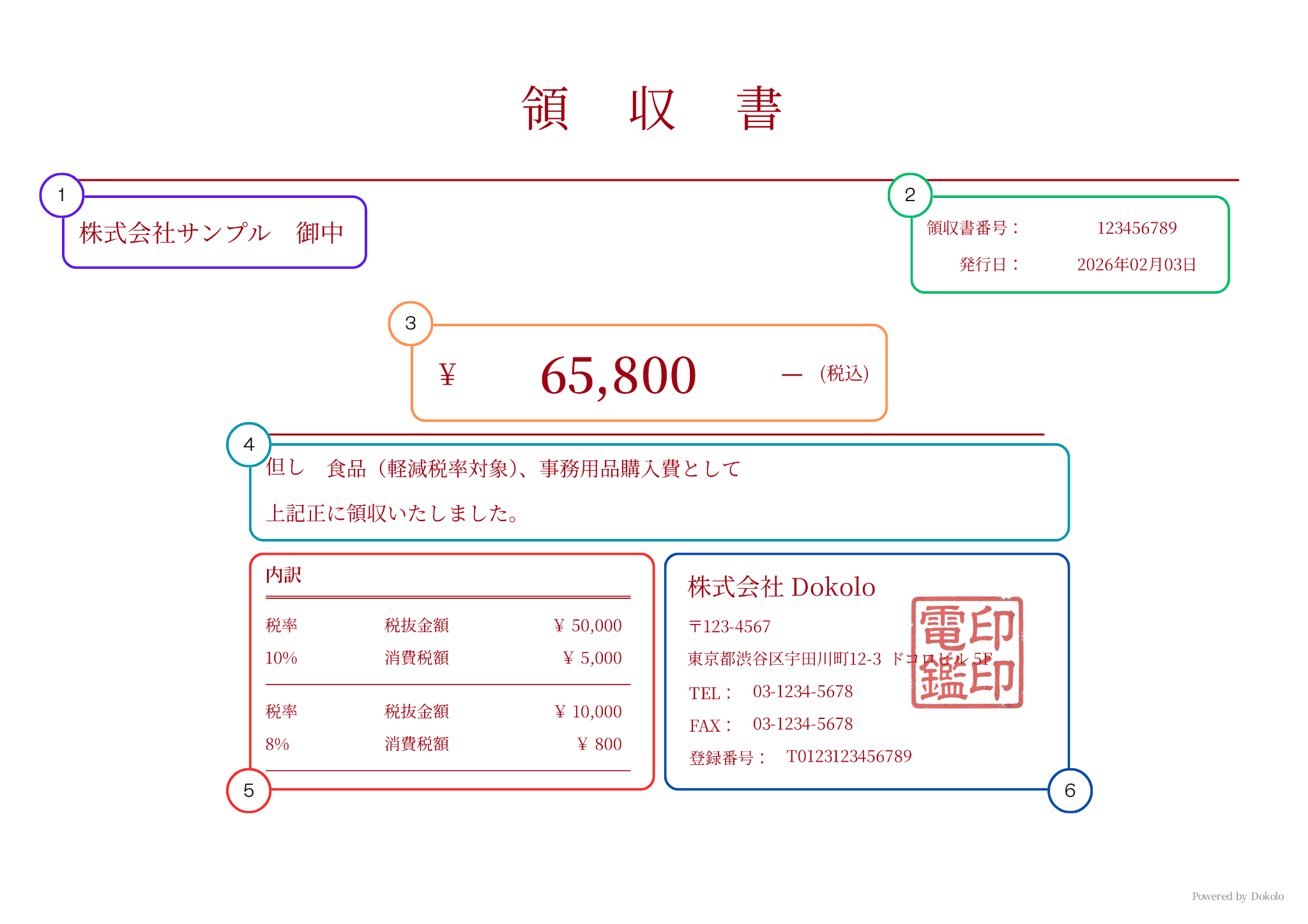
1. Addressee (宛名)
Write the company name or personal name of the payer. On a qualified invoice, the name of the business receiving the document is a required item[3].
Add 御中 (onchū) after a company or department and 様 (sama) after a person’s name. In Japanese practice you use only one of the two on a single addressee[7]. When the addressee can be left out is explained under “Simplified qualified invoices” below.
- 株式会社サンプル 御中
- 株式会社サンプル 経理部 御中
- 株式会社サンプル 経理部 山田 太郎 様
- 山田 太郎 様
2. Receipt number and issue date
The receipt number is a reference for reissuing and matching payments. It is not one of the qualified invoice items[3]. If you correct a receipt and hand it over again, see Correcting or reissuing a Japanese invoice.
In practice the date is the day you received payment, written with the full year — not shortened to “26年” or “R8年”[8].
The qualified invoice item “transaction date” (取引年月日) is the day the goods were delivered or the service was provided[3]. If that differs from the payment date, put the period in the purpose line — for example “10月分” (for October) — so the transaction date can be read from the receipt. Listing a period’s transactions together is allowed[9].
3. Amount
Write the total you received. In the sample it is 65,800 yen including tax, the same as the sum of the breakdown in block 5.
Japanese practice is to put “¥” or “金” before the figure, separate thousands with commas, and end it with “-”, “※” or “也”. This stops anyone from adding digits later[8].
- ¥65,800-
- ¥65,800※
- 金65,800円也
4. Purpose line (但し書き)
State what the payment was for, usually in the form “〇〇代として” (as payment for …). A vague line such as “お品代” (for goods) does not say what was bought, so avoid it[8].
- Webサイト保守料(10月分)として
- ロゴデザイン制作費として
- 書籍代として
- セミナー参加費として
On a qualified invoice, a description of what was supplied is a required item, and if it includes reduced-rate items you must say so[3]. The sample’s “食品(軽減税率対象)” (food, reduced rate) does this. You can also mark items with “※” and add a note such as “※は軽減税率対象”[9].
5. Tax breakdown by rate
Show the consideration for each tax rate (excluding or including tax), the applicable rate, and the consumption tax for each rate. All three are qualified invoice items[3]. The sample uses tax-exclusive amounts: 50,000 yen at 10% with 5,000 yen of tax, and 10,000 yen at 8% with 800 yen of tax.
If you issue the receipt as a qualified invoice, round fractions of a yen in the consumption tax once per rate on each receipt. You may round down, round up or round to the nearest yen[10].
As of October 2026, the reduced 8% rate applies to food and beverages (excluding alcoholic beverages and dining out) and to newspapers published at least twice a week and sold by subscription[11]. A government plan approved by the Cabinet on September 15, 2026 would lower the consumption tax rate on food and beverages to 1% (national and local combined) for two years, from April 1, 2027 to March 31, 2029. It takes effect only if the bill passes, and as of October 22, 2026 it has not[12].
If you live in Japan
To issue the receipt as a qualified invoice, show the total consideration for each tax rate and the applicable rate, and the consumption tax for each rate[3]. If you are not registered, see the box under “6. Issuer and registration number”.
If you live outside Japan (e.g. Korea)
If you did custom work such as design or software development in Korea and delivered it online, the payment is almost always for a transaction outside Japan (国外取引), so no Japanese consumption tax applies[13][14]. Ongoing online consulting, SaaS and other electronic services (電気通信利用役務), or work done in Japan, are treated differently. Guides on those cases are available in Japanese and Korean only: see the Japanese guide index or the Korean guide index[13].
6. Issuer and registration number
Write your name or business name, and add your registration number (登録番号) if you are registered. Together they make up the first qualified invoice item[3]. The number is “T + corporate number” for a business with a corporate number, and “T + 13 digits” for any other business[15].
Address, phone number and seal impression are not qualified invoice items[3]. Adding an address and phone number as contact details is common practice[8].
If you live in Japan
Only a registered qualified invoice issuer (適格請求書発行事業者) can show a registration number. As a rule, a qualified invoice issuer must issue a qualified invoice when a client that is a taxable business asks for one[15]. A business that is not registered can still issue ordinary receipts that are not qualified invoices, but anything that could be mistaken for a qualified invoice, such as a number resembling a registration number, is prohibited[16]. The system as a whole is explained in Japan’s qualified invoice system.
If you live outside Japan (e.g. Korea)
If all your sales are transactions outside Japan (not subject to Japanese consumption tax), such as custom work done in Korea, you have no obligation to issue qualified invoices[17]. Registering removes the consumption tax exemption regardless of your sales volume, so you may have to file Japanese consumption tax returns[15].
Simplified qualified invoices: when the addressee can be left out
A qualified invoice issuer in retail, restaurants, photography, travel, taxis or parking for the general public, or in a similar trade that supplies many unspecified customers (不特定かつ多数の者), can issue a simplified qualified invoice (適格簡易請求書) instead of a full one[18].
A simplified qualified invoice does not need the addressee (the receiving business’s name). It needs only one of the two: the consumption tax for each rate, or the applicable rate[19]. The simplified invoice is covered in full in Japan’s qualified invoice system.
Ordinary business-to-business deals — where you identify the client, sign a contract and supply what it specifies — generally do not qualify[20]. For work taken on client by client, write the addressee on the receipt.
When a receipt needs a revenue stamp
A paper receipt is a Category 17 document under Japanese stamp duty (印紙税): a “receipt for money or securities”. The title does not matter — a cash register receipt, or an invoice marked “代済” or “相済” (paid), counts too if it is made to prove payment was received[4]. The duty table and the 50,000-yen test are in Revenue stamps on Japanese receipts.
A receipt sent as a PDF or other electronic data is not a taxable document, so no stamp duty applies[5].
For receipts of sales proceeds, the duty depends on the amount written on the receipt[4][21].
| Amount received as stated | Stamp duty |
|---|---|
| Under 50,000 yen | None |
| 50,000 yen to 1 million yen | 200 yen |
| Over 1 million to 2 million yen | 400 yen |
| Over 2 million to 3 million yen | 600 yen |
| Over 3 million to 5 million yen | 1,000 yen |
| Over 5 million to 10 million yen | 2,000 yen |
| Over 10 million to 20 million yen | 4,000 yen |
| Over 20 million to 30 million yen | 6,000 yen |
| Over 30 million to 50 million yen | 10,000 yen |
| Over 50 million to 100 million yen | 20,000 yen |
| Over 100 million to 200 million yen | 40,000 yen |
| Over 200 million to 300 million yen | 60,000 yen |
| Over 300 million to 500 million yen | 100,000 yen |
| Over 500 million to 1 billion yen | 150,000 yen |
| Over 1 billion yen | 200,000 yen |
| No amount stated | 200 yen |
The 50,000-yen test and consumption tax
If a business that is a consumption taxpayer (課税事業者) shows the consumption tax separately, or writes both the tax-inclusive and tax-exclusive amounts so the tax is clear, the tax is left out of the stated amount[22]. In the National Tax Agency’s example, “商品販売代金48,000円、消費税額等4,800円、合計52,800円” has a stated amount of 48,000 yen, so no duty applies[22].
Writing only “税込” (tax included) or “消費税10%を含む” (includes 10% tax) does not make the tax clear, so the tax-inclusive total is the stated amount. A tax-exempt business (免税事業者) must include the tax in the stated amount even if it shows it separately[22].
The sample shows the tax separately in its breakdown, so if the issuer is a consumption taxpayer the stated amount is the tax-exclusive 60,000 yen[22]. Handed over on paper in Japan, it would need a 200-yen stamp[4].
Receipts that need no stamp
- Receipts sent as a PDF or by email — electronic data is not a taxable document[5]. But if you email it and then also hand over the same receipt on paper, the paper copy can become a taxable document[23].
- Receipts stating under 50,000 yen — not taxable[4].
- Receipts not issued in the course of trade (営業に関しない受取書) — “trade” (営業) here means repeating the same kind of activity for profit. Activities of for-profit companies and of individuals who are merchants count as trade; activities of public-interest corporations and of individuals who are not merchants do not[4]. The work of individual doctors, dentists, lawyers, certified public accountants and the like is generally not treated as trade either[24].
- Receipts for credit card payments — no money changes hands, so they are not Category 17-1 documents. But if the receipt does not state that the payment was made by credit card, it is taxable[25].
How to affix the stamp, and what happens if you don’t
The person who makes the receipt — the issuer — affixes the stamp, then cancels it with a seal or signature placed across both the receipt and the stamp’s pattern[26].
If you fail to affix the stamp, a penalty tax (過怠税) of three times the original duty applies. It drops to 1.1 times if you report the omission on your own, before you learn that a tax audit will lead to the duty being assessed. If you affix the stamp but do not cancel it, the penalty is the stamp’s face value. For the threefold penalty and the uncanceled-stamp penalty, if the total comes to less than 1,000 yen, it is 1,000 yen; this minimum does not apply to the self-reported 1.1× case[27][28].
Checks before you hand it over
- The addressee, date, amount and purpose line match the actual transaction.
- The amount equals the total of the tax breakdown and ends with “-” or a similar mark.
- If it is a qualified invoice: registration number, transaction date, description, consideration and rate for each tax rate, consumption tax, and addressee are all there[3].
- If it is handed over on paper in Japan: a stamp matching the stated amount is affixed and canceled[4][26].
- Consumption tax, registration number and revenue stamp follow the box above that applies to you.
FAQ
Is a receipt addressed to 上様 (an unnamed customer) a qualified invoice?
No — a qualified invoice must show the name of the business receiving it, and 上様 is not a name[3]. A business that can issue simplified qualified invoices, such as a retailer, can leave the addressee out[18][19].
Can a handwritten receipt be a qualified invoice?
Yes. A handwritten receipt is a qualified invoice if it carries all the required items[3].
My client asked for a paper receipt. Can I send a PDF instead?
As a rule, no: if they ask for paper, give them a paper receipt. The person paying can demand a receipt in exchange for payment, and an electronic record is an option the payer may request instead of paper[6]. A paper receipt handed over in Japan needs a revenue stamp depending on the stated amount[4]. If you post it from Korea, see the box under “How to affix the stamp, and what happens if you don’t”.
Sources
- [1]
freee 請求書と領収書の違いとは?役割や収入印紙の取り扱いについて解説
2026年5月19日更新
- [2]
国税庁 適格請求書等保存方式に関するQ&A 問1(適格請求書等保存方式の概要)
令和8年5月改訂Primary source
- [3]
国税庁 適格請求書等保存方式に関するQ&A 問26(手書きの領収書)
令和6年4月改訂Primary source
- [4]
令和8年4月1日現在法令等Primary source
- [5]
国税庁 質疑応答事例 取引先にメール送信した電磁的記録に関する印紙税の取扱い
令和7年8月1日現在の法令・通達等Primary source
- [6]
e-Gov法令検索 現行法令(2026年10月19日確認)Primary source
- [7]
バクラク(株式会社LayerX) 請求書の正しい宛名の書き方は?
2025年6月25日更新
- [8]
freee 領収書の書き方を見本付きで解説!必須項目やルールなどのポイントは?
2024年4月16日更新
- [9]
令和8年4月1日現在法令等Primary source
- [10]
国税庁 適格請求書等保存方式に関するQ&A 問57(消費税額等の端数処理)
令和6年4月改訂Primary source
- [11]
令和8年4月1日現在法令等Primary source
- [12]
国税庁 飲食料品に係る2年間の消費税率引下げについて(リーフレット・法案成立前の改正案)
令和8年9月(法案成立前・2026年10月22日確認)Primary source
- [13]
令和8年4月1日現在法令等Primary source
- [14]
国税庁 国境を越えた役務の提供に係る消費税の課税に関するQ&A(問2-1)
令和8年6月改訂Primary source
- [15]
国税庁 No.6498 適格請求書等保存方式(インボイス制度)
令和8年4月1日現在法令等Primary source
- [16]
国税庁 適格請求書等保存方式に関するQ&A 問26-2(免税事業者の交付する請求書等)
令和8年4月改訂Primary source
- [17]
国税庁 適格請求書等保存方式に関するQ&A 問23(適格請求書の交付義務)
令和5年10月改訂Primary source
- [18]
国税庁 適格請求書等保存方式に関するQ&A 問24(適格簡易請求書の交付ができる事業)
令和5年10月改訂Primary source
- [19]
国税庁 適格請求書等保存方式に関するQ&A 問58(適格簡易請求書の記載事項)
令和5年10月改訂Primary source
- [20]
国税庁 適格請求書等保存方式に関するQ&A 問24-2(適格簡易請求書を交付することができる事業の具体例)
令和6年4月追加Primary source
- [21]
国税庁 No.7141 印紙税額の一覧表(その2)第5号文書から第20号文書まで
令和8年4月1日現在法令等Primary source
- [22]
国税庁 No.7124 消費税及び地方消費税の金額が区分記載された契約書等の記載金額
令和8年4月1日現在法令等Primary source
- [23]
福岡国税局 文書回答事例 注文請書の現物交付に替えて電磁的記録を送信する場合の印紙税の課税関係(別紙)
平成20年10月24日回答Primary source
- [24]
令和8年4月1日現在法令等Primary source
- [25]
令和7年8月1日現在の法令・通達等Primary source
- [26]
令和8年4月1日現在法令等Primary source
- [27]
令和8年4月1日現在法令等Primary source
- [28]
e-Gov法令検索 2026年10月1日施行版(2026年10月21日確認)Primary source
- [29]
令和7年8月1日現在の法令・通達等Primary source
- [30]
令和7年8月1日現在の法令・通達等Primary source
- [31]
国税庁 印紙税法基本通達 第49条(作成場所が法施行地外となっている場合)
2026年10月19日確認Primary source
Last verified