

How to Write an Estimate in Japan (見積書): Numbered Sample, Validity Period, and Tax Display
A walkthrough of the Japanese estimate (見積書, mitsumorisho) using a numbered sample and a close-up of the line-item table. It also covers how to set the validity period, tax-inclusive vs. tax-exclusive amounts, copyright terms that affect withholding, and record retention.
- Last verified
- 31 sources
- 14 min read
Who this is forSole proprietors and companies that prepare estimates for clients in Japan, whether you live in Japan or outside it, for example in Korea.
Short answer
- No law prescribes what a Japanese estimate must contain; the format is a matter of practice[1]. A common layout has six blocks: addressee, estimate number with date and validity period, subject and estimated total, issuer, line-item table, and notes.
- Validity periods are commonly set between two weeks and six months, and no law fixes the length[2][3].
- Estimates are not covered by the tax-inclusive price display rule (総額表示義務), so you may quote tax-exclusive amounts[4]. If consumption tax applies, state which basis you use and show the tax by rate, so the later invoice matches.
- Consumption tax, the registration number, and withholding tax work differently depending on whether you live in Japan or outside it, for example in Korea. Those fields have side-by-side boxes for each case.
On this pageWhat an estimate is for and when to send it
What an estimate is for and when to send it
An estimate (見積書, mitsumorisho) sets out the price, quantity, and scope of goods or services before a contract is made. The client uses it to decide whether to place an order. Issuing an estimate is not a legal requirement[1].
A deal typically runs from estimate to order or contract, delivery, invoice, and receipt[1]. For the later documents, see How to write an invoice in Japan and How to write a receipt in Japan.
The amounts and terms in your estimate become the baseline for the order and the invoice. Pin down the scope of work and your assumptions before you send it.
How to write an estimate in Japan: the numbered sample
The sample below is an estimate made in Dokolo, split into six numbered blocks. The sections that follow explain what goes in each block. Besides 見積書, the more formal title 御見積書 is also acceptable[2].
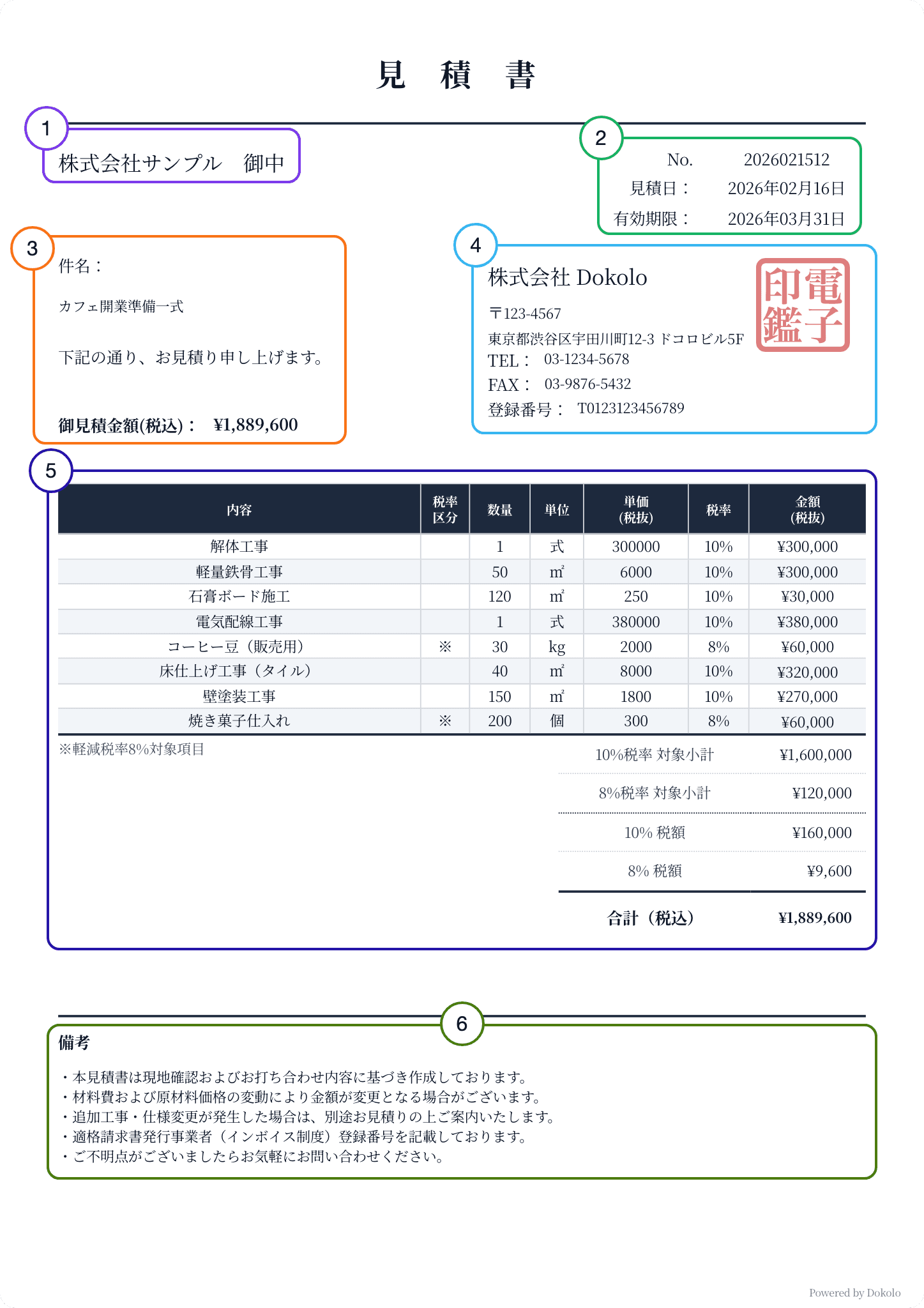
1. Addressee (宛名)
Write the client company or person. Add the honorific 御中 (onchū) after a company or department, or 様 (sama) after a person. In practice, you never use both on the same addressee[5].
- 株式会社サンプル 御中
- 株式会社サンプル 総務部 御中
- 株式会社サンプル 総務部 山田 太郎 様
- 山田 太郎 様
2. Estimate number, date, and validity period
The estimate number is a reference number that lets you identify which estimate a question or order refers to. Use a running number or a project number. The estimate date is the day you issue it, and the validity period runs from that date[2].
The validity period (有効期限) is how long the client can accept your price and terms. You can state a period, such as 発行日より1か月間有効 ("valid for one month from the date of issue"), or a date, such as 2027年3月31日まで ("until March 31, 2027"). Periods of two weeks to six months are common[2][3].
Under the Japanese Civil Code, an offer that sets a period for acceptance cannot be withdrawn unless the offeror reserved the right to withdraw it. If no acceptance arrives within the period, the offer lapses[6].
Where the estimate counts as an offer, accounting software guides (Yayoi, freee) apply this rule to an estimate with a validity period: until it expires, you cannot change the price on your own[2][3]. If material or labor costs change often, set a shorter period or note in the remarks when the price may change[2].
3. Subject (件名) and estimated total
The subject names the project, task, or period so the client can see at a glance what the estimate covers. In the sample, the tax-inclusive total (御見積金額) appears under the line 下記の通り、お見積り申し上げます。 ("We are pleased to quote as follows."). It must match the total of the line-item table in block 5.
4. Issuer and registration number
Write your name or business name, and add an address and phone number for inquiries. Many issuers also stamp a company seal. Both are customary; no law prescribes the contents of an estimate[1].
If you live in Japan
If you are registered, showing your registration number on the estimate lets the client confirm before ordering that you are a qualified invoice issuer (適格請求書発行事業者). If the client files under the general method (一般課税), purchases from an unregistered business qualify only for a 70% credit under the transitional measure. This rate applies from October 1, 2026 to September 30, 2028; in taxable periods beginning on or after October 1, 2026, purchases from a single supplier above 100 million yen a year are excluded[7]. How to register is covered in Japan’s qualified invoice system.
If you live outside Japan (e.g. Korea)
Custom work done in Korea is a transaction outside Japan (国外取引), so it carries no Japanese consumption tax[8]. A client’s input tax credit covers taxable purchases made in Japan and certain other items, not transactions outside Japan, so your registering gives the client no benefit[9]. Registering removes the consumption tax exemption regardless of your sales volume, so you may have to file Japanese consumption tax returns[10].
5. Line-item table
This block lists the description, quantity, unit, unit price, tax rate, and amount on each line, followed by subtotals and tax by rate and the grand total. The next section, "Filling in the line-item table," explains each column.
6. Notes (備考)
Use the notes for terms the amount alone does not convey: assumptions, delivery date, and payment terms[1]. Settling how extra work or specification changes will be handled here prevents misunderstandings after the order.
If you have agreed whether the copyright in the deliverables will be transferred or licensed, note that too. The section "Withholding tax and copyright terms" explains why it matters.
If you will be paid by international transfer, state who bears the transfer fees. According to Sumitomo Mitsui Banking Corporation, even when the sender pays the fees, the recipient’s bank or an intermediary bank may still deduct charges[11].
Filling in the line-item table
The line-item table shows how you arrived at the estimated total. Follow the numbers in the close-up below to see what goes in each column.
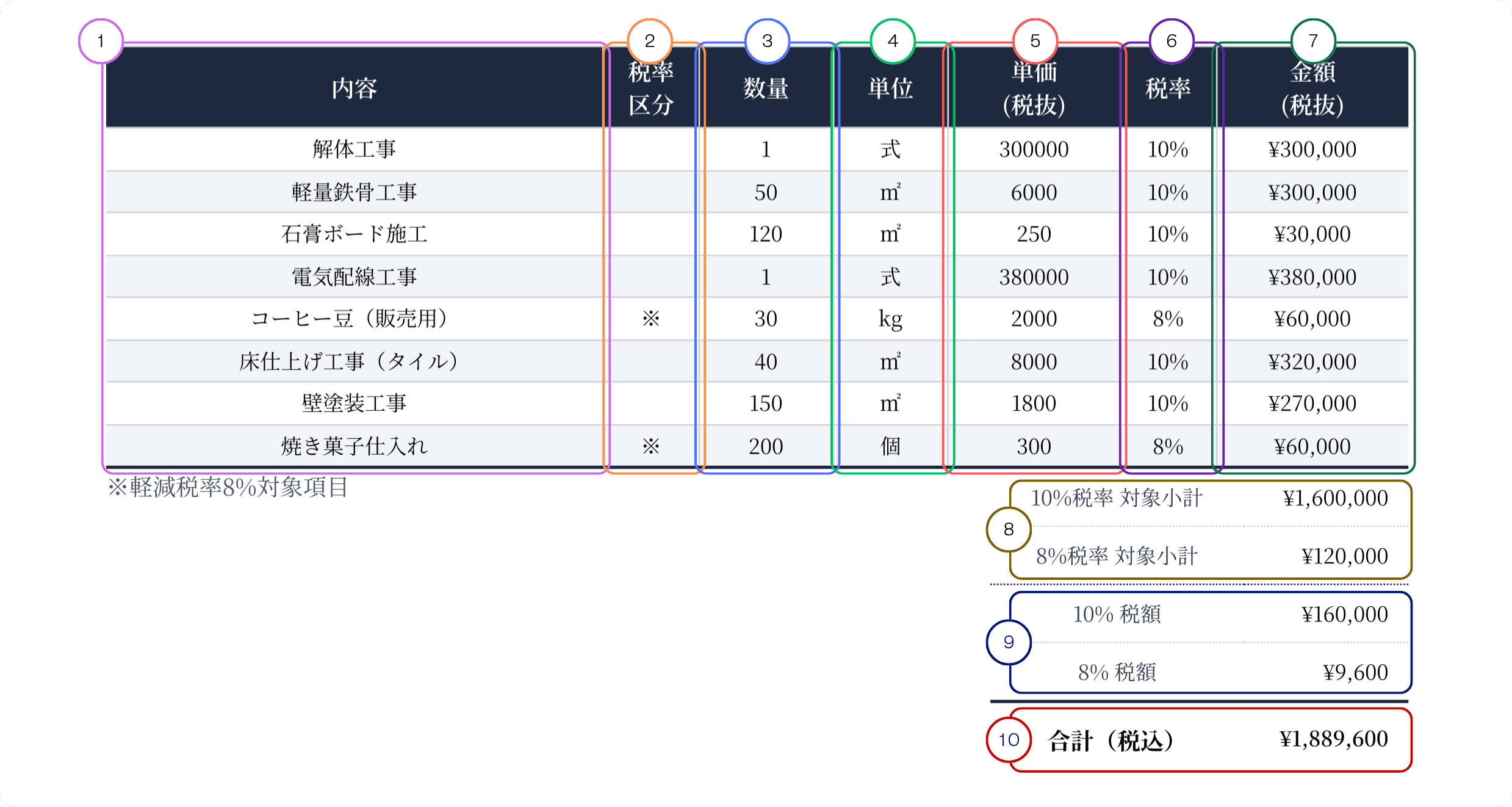
| No. | Column | What to write |
|---|---|---|
| 1 | Description (内容) | The work, item, or service. Write it so a third party can tell what was quoted, and break a lump sum (一式) into stages or items so the client can check it. |
| 2 | Tax category (税率区分) | Mark reduced-rate (8%) lines with a symbol such as ※ and explain the symbol below the table, the same way as on a qualified invoice[12]. |
| 3 | Quantity (数量) | Number of items, area, hours, and so on. Use 1 for a fixed-price job. |
| 4 | Unit (単位) | The unit of the quantity, such as 式 (lot), ㎡, 個 (piece), or 時間 (hour). |
| 5 | Unit price, excl. tax (単価) | The price per unit. The sample is tax-exclusive; if you use tax-inclusive prices, use them on every line. |
| 6 | Tax rate (税率) | 10% or 8%. |
| 7 | Amount, excl. tax (金額) | Quantity times unit price. |
8 to 10. Subtotals, tax, and total by rate
Item 8 is the total for each tax rate, item 9 the consumption tax for each rate, and item 10 the grand total. Item 10 must match the estimated total in block 3.
If you will issue the invoice as a qualified invoice, fractions of a yen in consumption tax are rounded once per tax rate per document. Rounding tax line by line and adding up the results is not allowed[13]. Calculating the estimate the same way keeps the estimate and the invoice from differing by a yen.
Tax-inclusive vs. tax-exclusive amounts and the reduced rate
Japan’s price display rule requires businesses to show tax-inclusive prices when they display prices to consumers in advance[14]. Estimates, contracts, and invoices are outside the rule, so you may quote tax-exclusive amounts on an estimate[4].
If consumption tax applies, state whether the amounts include or exclude tax. The sample shows tax-exclusive line items and the tax-inclusive total in blocks 3 and 10.
As of October 2026, the reduced 8% rate applies to food and beverages (excluding alcoholic beverages and dining out) and to newspapers published at least twice a week and sold by subscription[15]. The coffee beans and baked goods in the sample are food, so they are at 8%; the construction work is at the standard 10%[15].
A government plan approved by the Cabinet on September 15, 2026 would lower the consumption tax rate on food and beverages to 1% (national and local combined) for two years, from April 1, 2027 to March 31, 2029. It takes effect only if the bill passes, and as of October 22, 2026 it has not[16]. If consumption tax applies and you quote food and beverages to be delivered in that period, check the rate in the National Tax Agency’s guidance before sending the estimate.
If you live in Japan
If you plan to issue the invoice as a qualified invoice, split the estimate by tax rate too, so its figures line up with the invoice. A qualified invoice must show the amount and applicable rate for each tax rate, and the consumption tax for each rate[12]. The full list of required items is in Japan’s qualified invoice system.
If you live outside Japan (e.g. Korea)
Custom work done in Korea and delivered online is usually a transaction outside Japan (国外取引), so no Japanese consumption tax applies[8][17]. If the service is a business-to-business electronic service (電気通信利用役務), such as ongoing online consulting, include a notice such as 日本の消費税のリバースチャージ方式の対象取引です。 ("This transaction is subject to Japanese consumption tax under the reverse charge mechanism.") in the documents or emails you exchange from the start of negotiations[17].
Withholding tax and copyright terms
Withholding tax (源泉徴収) is income tax that the paying client deducts and pays to the government; the duty is on the payer[18][19]. Because it changes the amount you receive, confirm with the client at the estimate stage whether tax will be withheld and at what rate.
If you live in Japan
If the client is a withholding agent, such as a company or a sole proprietor who pays salaries, it withholds 10.21% (20.42% on the part of a single payment over 1 million yen) from design fees, writing fees, and similar fees paid to individuals[18][20]. As a rule, nothing is withheld when the payer is an individual with no salary withholding duty, or when the payee is a company[21][22].
If you live outside Japan (e.g. Korea)
Payment for work performed only in Korea is not subject to Japanese withholding[23]. If it includes payment for transferring (buying out) or licensing copyright, that payment is a royalty taxed at 20.42%. The rate is 10% if the beneficial owner is a resident of Korea and the 租税条約に関する届出書 (Application Form for Income Tax Convention) is filed through the client by the day before the first payment[19][24][25][26]. The tax authorities look at substance rather than the contract label[27], so settle the copyright terms in the estimate, and ask a tax accountant if you are unsure. Guides on withholding for businesses outside Japan are available in Japanese and Korean only: see the Japanese guide index or the Korean guide index.
How long to keep estimates
This section applies to sole proprietors and companies required to keep books and records under Japanese income tax or corporate tax law. Keep a copy of every estimate you issue.
- Companies: Keep documents prepared or received in connection with transactions for seven years from the day after the tax return deadline, or ten years for a fiscal year in which a loss arose under a blue return, among other cases. The documents to keep include estimates received from the other party and copies of estimates you prepared, if you kept copies[28][29].
- Sole proprietors filing a blue return (青色申告): Estimates fall under "other documents" (その他の書類) and are kept for five years[30].
- Sole proprietors filing a white return (白色申告): Documents prepared or received in the course of business are kept for five years[30].
Estimates exchanged as PDFs or by email are electronic transactions (電子取引) and must be kept as electronic data[31]. Drafts with mistakes, rough calculations made before a formal estimate, and unsolicited estimates from companies seeking your business do not need to be kept, according to the NTA Q&A[31]. The requirements for how to store the data are covered in the Electronic Bookkeeping Act guide.
Before you send
- The addressee, date, estimate number, subject, and validity period match the project
- Quantity times unit price, subtotals and tax by rate, the grand total, and the estimated total at the top all agree
- If consumption tax applies, you have stated whether the amounts include tax
- The notes cover assumptions, delivery, payment terms, and how extra work is handled, plus who bears transfer fees if you will be paid from abroad
- Consumption tax, the registration number, and withholding follow the box that applies to you
FAQ
What happens if an estimate has no validity period?
Nothing is wrong with it, and no law fixes the length of the period[3]. However, freee’s guide reads Article 525 of the Civil Code as meaning that, where the estimate counts as an offer, even one with no validity period cannot be withdrawn for a reasonable time needed to receive an acceptance, unless you reserved the right to withdraw it[3][6]. Most issuers state a period to make clear how long the price stands[2].
Can I quote tax-exclusive amounts on a Japanese estimate?
Yes. Estimates, contracts, and invoices are outside the tax-inclusive price display rule[4]. If consumption tax applies, state that the amounts exclude tax and show the tax-inclusive total as well, so the client can compare it with its budget.
Sources
- [1]
マネーフォワード クラウド請求書 見積書の書き方・作り方!Excelテンプレも
2026年4月16日更新
- [2]
2026年10月19日確認
- [3]
freee 見積書の有効期限に目安はある?期限の決め方や記載なしの場合も解説
2024年6月20日更新
- [4]
国税庁 No.6902 「総額表示」の義務付け Q&A(総額表示義務のない場合)
令和8年4月1日現在法令等Primary source
- [5]
バクラク(株式会社LayerX) 請求書の正しい宛名の書き方は?
2025年6月25日更新
- [6]
民法 第523条(承諾の期間の定めのある申込み)・第525条(承諾の期間の定めのない申込み)
e-Gov法令検索 現行法令(2026年10月19日確認)Primary source
- [7]
令和8年度税制改正(2026年10月19日確認)Primary source
- [8]
令和8年4月1日現在法令等Primary source
- [9]
e-Gov法令検索 現行法令(2026年10月19日確認)Primary source
- [10]
国税庁 No.6498 適格請求書等保存方式(インボイス制度)
令和8年4月1日現在法令等Primary source
- [11]
2026年2月
- [12]
令和8年4月1日現在法令等Primary source
- [13]
国税庁 適格請求書等保存方式に関するQ&A 問57(消費税額等の端数処理)
令和6年4月改訂Primary source
- [14]
令和8年4月1日現在法令等Primary source
- [15]
令和8年4月1日現在法令等Primary source
- [16]
国税庁 飲食料品に係る2年間の消費税率引下げについて(リーフレット・法案成立前の改正案)
令和8年9月(法案成立前・2026年10月22日確認)Primary source
- [17]
国税庁 国境を越えた役務の提供に係る消費税の課税に関するQ&A(問2-1・問20)
令和8年6月改訂Primary source
- [18]
e-Gov法令検索 現行法令(2026年10月19日確認)Primary source
- [19]
国税庁 No.2884 非居住者等に対する源泉徴収・源泉徴収の税率
令和8年4月1日現在法令等Primary source
- [20]
令和8年4月1日現在法令等Primary source
- [21]
令和8年4月1日現在法令等Primary source
- [22]
令和8年4月1日現在法令等Primary source
- [23]
令和8年4月1日現在法令等Primary source
- [24]
国税庁 No.2888 租税条約に関する届出書の提出(源泉徴収関係)
令和8年4月1日現在法令等Primary source
- [25]
令和7年8月1日現在の法令・通達等Primary source
- [26]
財務省 日本国と大韓民国との間の租税条約(第12条 使用料)
2026年10月20日確認Primary source
- [27]
国税不服審判所 平成21年12月11日裁決(裁決事例集No.78 開発委託費・イラスト制作費と著作権の譲渡の対価)
平成21年12月11日裁決Primary source
- [28]
令和8年4月1日現在法令等Primary source
- [29]
法人税法施行規則 第59条第1項第3号・第67条第1項第1号(帳簿書類の整理保存)
e-Gov法令検索 現行法令(2026年10月19日確認)Primary source
- [30]
国税庁 暮らしの税情報(令和8年度版)記帳や帳簿等保存・青色申告
令和8年度版Primary source
- [31]
令和8年7月Primary source
Last verified