

Invoicing as a Designer in Japan: Withholding Tax and What to List
For freelance designers billing clients in Japan, whether you live in Japan or abroad. Decide whether your work is subject to Japanese withholding tax, whether your client withholds, and how to split the line items. Based on National Tax Agency (NTA) and e-Gov sources checked on November 7, 2026.
- Last verified
- 23 sources
- 16 min read
Who this is forIndividual designers (freelancers and sole proprietors) who bill companies or individuals in Japan. The rules differ for tax residents of Japan and for non-residents; the first section tells you which part applies to you.
Short answer
- If you are a tax resident of Japan, fees for graphic design (ads, posters, wrapping paper and similar), package, interior and industrial design are subject to withholding tax (源泉徴収). A company, or a sole proprietor who pays salaries, deducts 10.21% (20.42% on the part of a single payment above ¥1,000,000)[1][2][3].
- If you are a non-resident for Japanese tax purposes, a fee purely for work done outside Japan has no Japanese withholding. A copyright license or transfer fee paid by a client doing business in Japan, relating to that business, is generally subject to 20.42%, which a tax treaty may reduce or remove[4][5].
- Website and app interface design is not named in the NTA circular’s examples, but in Japanese practice it is generally treated as visual design, like graphic design, and so as subject to withholding. That is a practice view drawn from tax accountants’ guidance and answers, not a statutory rule. Coding and CMS setup fees are not on the list, so they are not subject. With separate lines only the design fee is withheld on; bill it as one "Web制作一式" (website production, all-in) line and the whole amount is[2][6][7][8][9].
- If you are a tax resident of Japan, there is no withholding when the client is an individual who pays no salaries. Nor is there any when you receive the fee through your own Japanese corporation[10][11].
- If you are a tax resident of Japan, travel you pay and then bill is in principle part of the fee and withheld on. For materials and printing, if you pay a cost the client bears and bill it at cost on a line separate from the design fee, Japanese practice leaves that reimbursement (立替金) out and withholds only on the design fee. Fold it into an all-in price or add a markup and it becomes part of the fee[3][12][13].
No sign-in needed to fill it in and download the PDF.
On this pageFirst: are you a tax resident of Japan or a non-resident?
First: are you a tax resident of Japan or a non-resident?
Japanese withholding covers different fees, at different rates, for tax residents of Japan (居住者) and for non-residents (非居住者): people with no domicile in Japan and no residence there for a year or more[1][5]. The rest of this page is written for residents, so check which applies to you first.
If you live in Japan
If you live and work in Japan as a tax resident, for example as a foreign designer based in Tokyo, read on from "Which design work is covered". Design fees are listed in Article 204(1)(i) of the Income Tax Act (所得税法), so a client who is a withholding agent, such as a company, deducts 10.21%[1][3].
If you live outside Japan (e.g. Korea)
The 10.21% rule on this page does not apply to non-residents. A fee purely for design work done outside Japan is not Japan-source income, so no Japanese tax is withheld[4]. A fee for licensing or transferring (buying out) copyright, paid by a client doing business in Japan and relating to that business, is generally subject to 20.42% withholding. A tax treaty between Japan and your country may reduce or remove it; to claim that, the "Application Form for Income Tax Convention" (租税条約に関する届出書) has to be filed through the client by the day before the payment[5]. If your contract transfers copyright, first work out whether the fee pays for the work or for the rights. For residents of Korea, see Korea-to-Japan Withholding Tax: Work Fees and Royalties.
Design fees subject to withholding: the circular’s examples and website and app screens
Article 204(1)(i) of the Income Tax Act lists "design fees" (デザインの報酬) paid to residents as subject to withholding[1]. The NTA’s Income Tax Basic Circular 204-7 gives examples of what counts as design, introducing them as things design "includes"[2]. Use the table to find the category closest to your work.
| Category in the circular | Examples the circular gives | Typical freelance work |
|---|---|---|
| Graphic design | Design of ads, posters, wrapping paper and similar[2] | Flyers, posters, magazine ads, wrapping paper |
| Package design | Design of containers for cosmetics, medicines, food and similar[2] | Product boxes and bottles |
| Advertising design | Design of neon signs, illuminations, advertising towers and similar[2] | Outdoor signboards and signage |
| Interior design and display | Interior decoration of rooms, including passenger cabins, and display decoration of shop windows, shelves and exhibition halls[2] | Shop interiors, trade-show booths, in-store displays |
| Industrial, craft and fashion design | Design of cars, furniture and textiles; household goods such as teacups and ashtrays; clothing and accessories[2] | Product design, homeware, clothing and accessories |
The circular also lists golf courses, gardens and amusement parks. By contrast, a fee for painting lettering or pictures on a signboard is treated as similar to design but not a design fee[2].
In its interpretive Q&A, the NTA treats illustrations and lettering for an advertising poster, and lettering and graphics made for TV captions (テロップ), as design fees. The caption case describes design as, generally, planning a practical and aesthetic form and expressing it visually[14][15]. Because the circular’s categories are examples, work it does not name, such as a logo or business cards, is not excluded just because it is missing from the list.
Website and app design: screen design is covered, coding is not
Website and app interface (UI) design is not among the examples in Circular 204-7[2], and the law has no express rule on it. In Japanese practice, though, the layout, colour and lettering of a screen are generally treated as visual design, like graphic design, and so as a design fee. A Japanese accounting software company’s guide supervised by a tax accountant, and a tax accountant’s public answer, both take this view[7][8]. It is a practice view, not a statutory rule. The guidance we checked uses website design as its example; an app screen is the same kind of screen design.
Coding and system development fees, by contrast, are not listed in Article 204(1) of the Income Tax Act or Article 320(1) of its Enforcement Order, so they are not subject to withholding[1][6]. Pure implementation work with no visual design in it is the same[8]. When one project bundles design and coding, practice is to withhold only on the design part if the invoice separates it, and on the whole amount if it does not[7][9]. Programming, system development and websites covers the same point from the general withholding guide.
- Put the design fee, coding and content management system (CMS) setup on separate invoice lines. A single "Web制作一式" (website production, all-in) line includes design, so the whole amount becomes subject to withholding[7][9].
- At the quote stage, tell the client that only the design line is subject to withholding[7]. If the lines are separated and the client still withholds on coding, then for a tax resident of Japan that amount was not required to be withheld: it cannot be settled through your final tax return (確定申告), and you have to claim it back from the client[16].
It depends on who pays: companies, sole proprietors and private clients
Withholding is done by the client who pays the fee[1]. The same logo can be billed with or without withholding depending on who the client is. This table assumes you are an individual resident of Japan.
| Client | Withholding |
|---|---|
| A company or other corporation | Yes[17] |
| A sole proprietor who pays salaries to employees or family members (including a family-member salary under the blue-return system, 青色事業専従者給与) | Yes, even if no tax is actually withheld from those salaries[10] |
| An individual who pays no salaries (a sole proprietor, or a private client ordering, say, wedding invitations) | No. The same applies to an individual whose only salaries go to two or fewer regular domestic workers. What counts is whether they pay salaries, not why they ordered the work[10] |
You cannot tell from outside whether a sole proprietor pays salaries. Ask whether they will withhold before you prepare the invoice, so you do not have to redo the net amount. See Who withholds for the details.
If you bill through your own Japanese company, no tax is withheld from the design fee, even when the client is a company. For a Japanese domestic corporation, the only fee or charge subject to withholding is horse racing prize money paid to a corporate horse owner[11].
Line items: separate design fees, revisions and expenses
The description of what you supplied is one of the required items on a qualified invoice (適格請求書)[18]. Japanese invoicing guides advise listing each billed item separately when several jobs go on one invoice[19]. On a design invoice, that means one line per deliverable, separate lines for extra revisions, and separate lines for expenses you paid. Separate lines make it easy for the client to see which ones it will withhold on, and keep items that may be treated differently, such as coding or printing, apart.
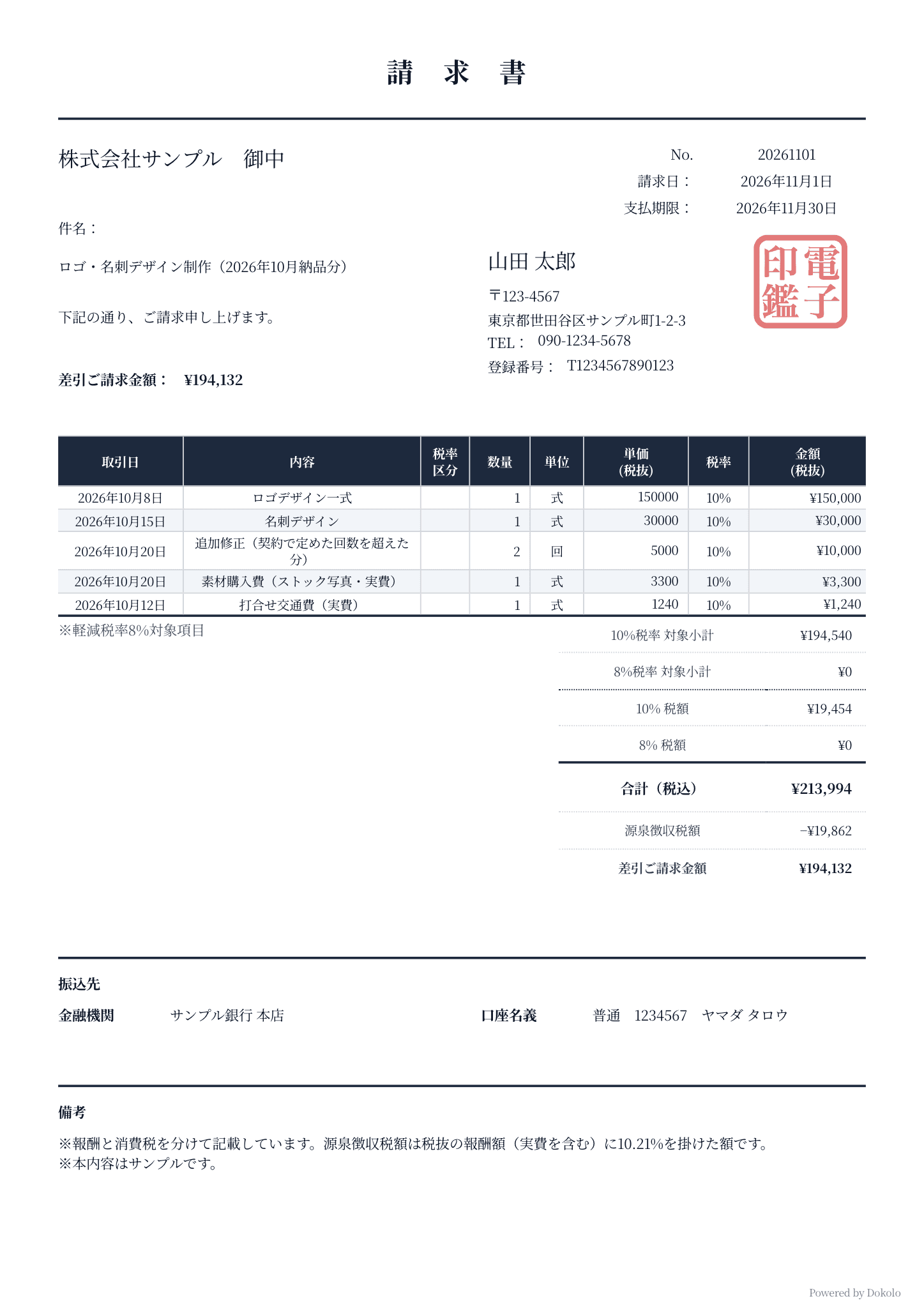
| Line item | Quantity × unit price (before tax) | Subject to withholding? |
|---|---|---|
| ロゴデザイン一式 (logo design, one set) | 1 × ¥150,000 | Yes (design fee) |
| 名刺デザイン (business card design) | 1 × ¥30,000 | Yes (design fee) |
| 追加修正 (revisions beyond the contracted number) | 2 × ¥5,000 | Yes. A fee in the nature of a design fee is covered even if it is called a revision charge[12] |
| 素材購入費 (stock photo purchase, at cost) | 1 × ¥3,300 | Yes if billed as part of the fee, as this example assumes. If it is a reimbursement, at cost, of material bought for the client and borne by the client, practice treats it as not covered (see "Expenses, travel and printing")[12][13] |
| 打合せ交通費 (travel to meetings, at cost) | 1 × ¥1,240 | In principle, yes[3] |
"One set" (一式) suits work delivered as a single piece, such as a logo, and Japanese invoicing guides mention it as a way to group long lists[19]. For work priced by count, such as five banners or ten pages, quantity × unit price lets the client check additions or reductions against the estimate. The fields outside the line items, such as the recipient and bank details, are covered in How to Write an Invoice in Japan.
Expenses, travel and printing: are they part of the fee?
Travel and accommodation billed together with the fee are in principle included in the amount subject to withholding: the NTA says these costs are in principle part of the fee[3]. For other expenses, such as materials, the circular says payments in the nature of a fee are covered even when they are called honoraria, material costs, transport costs and similar[12]. Its condition is that the payment has the nature of a fee; it does not say the same for a pure reimbursement of something you bought on the client’s behalf.
The law has no express rule on reimbursements (立替金), but in Japanese practice, materials or printing that the client bears, paid by you and billed at cost on a line separate from the fee, are generally left out of the withholding base, and only the design fee is withheld on. A tax accountant’s public answer on outsourced printing paid by the designer and passed on to the client takes the same line[13]. If you fold the cost into an all-in price or add a markup, it has the nature of a fee and is covered even when labeled as material costs[12]. Travel and accommodation are different: the NTA treats them as in principle part of the fee[3].
| Cost | Treatment |
|---|---|
| Travel and accommodation you pay and then bill | In principle included[3] |
| Travel and accommodation the client pays directly to the transport company or hotel, within the normally needed amount | Tax need not be withheld on this amount[12]. The cost does not appear on your invoice |
| Materials you buy and bill (stock photos, fonts and similar) | Covered if folded into the design fee or marked up, even when labeled as material costs[12]. If the material is bought for the client, borne by the client and billed at cost on its own line, practice treats it as a reimbursement and not covered[13] |
| Printing, when you take on design and printing together | For design and construction contracted together, the circular splits the payment and withholds on the design part, but says tax need not be withheld if the design part is extremely small. Its examples are neon signs, advertising towers, gardens and similar, and printing is not mentioned[2]. If you outsource the printing, pay the printer and bill that cost at cost on its own line, practice withholds only on the design fee[13] |
To keep materials or printing out of the withholding base, put them on separate lines at cost and tell the client, with the receipts, that they are reimbursements before you invoice. If the client contracts with and pays the stock photo site or printer directly, that cost never goes on your invoice.
Copyright transfers and licenses on the invoice
For residents of Japan, Article 204(1)(i) of the Income Tax Act lists royalties for copyright (including neighboring rights) in the same item as design fees[1]. Whether you bill a license fee or include it in the design fee, it falls under the same item, with the same rate and calculation[1][3].
The article names copyright "royalties", not payment for a transfer (buyout). The NTA materials checked for this page do not say how a separate "copyright transfer fee" line (著作権譲渡料) is treated. Since a payment in the nature of a fee is covered whatever it is called[12], confirm the withholding treatment with the client if you list it separately. If you live outside Japan, copyright fees follow different rules; see the first section.
Consumption tax and the withholding calculation
If you live in Japan
If you charge Japanese consumption tax, design work is not a reduced-rate item, so the standard 10% rate applies[20]. If the invoice shows the fee and the tax separately, the client can calculate withholding on the fee alone, even if it is not a qualified invoice[3][21]. Whether to register as a qualified invoice issuer is covered in what changes when a tax-exempt business registers.
If you live outside Japan (e.g. Korea)
For services, whether a transaction is inside Japan is generally decided by where the service is performed, with some exceptions. Design work done outside Japan is generally outside the scope of Japanese consumption tax[22]. The consumption tax part of How to Write an Invoice in Japan explains the exceptions, such as online services. Tax in your own country is a separate question.
Withholding Tax on Invoices in Japan shows how to calculate the withholding and the net amount due. The withholding tax calculator does the arithmetic from the fee.
FAQ
Is a fee for web design or app screen design subject to withholding?
If you are a tax resident of Japan: the law has no express rule, but Japanese practice generally treats screen design as a design fee and so as subject to withholding[7][8]. Coding and CMS setup are not on the list and are not subject, so with separate lines only the design fee is withheld on. Bill it as one "Web制作一式" line and the whole amount is[6][9]. If the client is an individual who pays no salaries, nothing is withheld even on the design fee[10]. If you are a non-resident, follow the rules in the first section.
What should a designer’s invoice include?
Japanese invoices usually show the recipient, issuer details, invoice date, invoice number, transaction date, description, subtotal, consumption tax and total, payment due date, bank details and notes[19]. The items required by law are those for a qualified invoice: issuer name and registration number, transaction date, description, amount and rate for each tax rate, consumption tax, and the recipient’s name[18]. If tax is withheld, it is common to add a separate withholding line next to the fee and the amount billed[23].
If I am paid into a bank account outside Japan, is nothing withheld?
The location of the account does not decide it. For Japan-source income subject to withholding, a client with an address or office in Japan is treated as paying in Japan even when it pays abroad, and withholds the tax[5]. Nothing is withheld when the fee is not Japan-source income in the first place, such as a fee purely for work done outside Japan[4], or when a tax treaty exempts it and the treaty application form has been filed by the day before payment[5].
Sources
- [1]
Income Tax Act, Articles 204 and 205 (e-Gov)
e-Gov Legal Search, current law (checked November 7, 2026)Primary source
- [2]
NTA Income Tax Basic Circulars 204-6 to 204-10 — Manuscript fees and the scope of design
Income Tax Basic Circular (checked November 7, 2026)Primary source
- [3]
NTA No. 2795 — Payments for manuscripts, lectures and similar fees
Laws and related provisions as of April 1, 2026Primary source
- [4]
NTA No. 2878 — Scope of Japan-source income
Laws and related provisions as of April 1, 2026Primary source
- [5]
NTA No. 2884 — Withholding and tax rates for non-residents and foreign companies
Laws and related provisions as of April 1, 2026Primary source
- [6]
Order for Enforcement of the Income Tax Act, Article 320(1) (e-Gov)
e-Gov Legal Search, current law (checked November 7, 2026)Primary source
- [7]
Updated April 16, 2026 (practice view; secondary source; checked November 8, 2026)
- [8]
Information as of publication on July 15, 2017 (practice view; secondary source; checked November 8, 2026)
- [9]
Information as of publication on June 12, 2021 (practice view; secondary source; checked November 8, 2026)
- [10]
NTA No. 2793 — Withholding agents for fees and charges
Laws and related provisions as of April 1, 2026Primary source
- [11]
NTA No. 2792 — Fees and charges subject to withholding
Laws and related provisions as of April 1, 2026Primary source
- [12]
Income Tax Basic Circular (checked November 7, 2026)Primary source
- [13]
Information as of publication on May 26, 2018 (practice view; secondary source; checked November 8, 2026)
- [14]
NTA interpretive Q&A — Fees paid to copywriters, illustrators and lettering artists
Laws, regulations and circulars as of August 1, 2025Primary source
- [15]
NTA interpretive Q&A — Fees for TV caption (telop) graphics
Laws, regulations and circulars as of August 1, 2025Primary source
- [16]
National Tax Tribunal ruling of November 27, 2006 — Case Reports No. 72, p. 246
Checked November 8, 2026Primary source
- [17]
NTA No. 2502 — Who is a withholding agent?
Laws and related provisions as of April 1, 2026Primary source
- [18]
NTA No. 6625 — Required information on qualified invoices and related documents
Laws and related provisions as of April 1, 2026Primary source
- [19]
freee — How to write an invoice: required information and preparation
Updated June 26, 2024 (business practice; secondary source)
- [20]
NTA No. 6102 — Reduced consumption tax rates
Laws and related provisions as of April 1, 2026Primary source
- [21]
NTA — Withholding on fees and charges after the invoice system begins
Published December 9, 2021 (checked November 7, 2026)Primary source
- [22]
NTA No. 6210 — Transactions outside Japan
Laws and related provisions as of April 1, 2026Primary source
- [23]
freee — Showing withholding tax on invoices: calculation, presentation and covered fees
Updated May 26, 2026 (business practice; secondary source)
Last verified