

Invoicing for Illustration Work in Japan: Withholding, Pen Names and Your Address
When you bill a company or an individual in Japan for illustration work, three questions come up: does the client withhold tax, can you use your pen name, and do you have to show your address? This guide answers them from National Tax Agency (NTA) and e-Gov sources checked on November 7, 2026. The rules differ depending on whether you are a resident of Japan for tax purposes, so start with the first section.
- Last verified
- 24 sources
- 13 min read
Who this is forFreelance illustrators, including foreign nationals, who take commissions from clients in Japan. If you are a tax resident of Japan, the main rules on this page apply. If you are a non-resident for Japanese tax purposes, the first section points you to the rules for non-residents. Working through your own company changes the answer too; see the relevant sections.
Short answer
- If you are a tax resident of Japan, fees for book or magazine illustrations and advertising artwork are subject to withholding tax when the client is a company or a sole proprietor who pays salaries. An individual who pays no salaries to anyone, such as a fan commissioning a piece, does not withhold[1][2][3].
- If you are a non-resident for Japanese tax purposes, non-resident rules apply instead. A copyright royalty or transfer fee paid by a client doing business in Japan, and connected with that business, is withheld at 20.42% in principle, which a tax treaty may reduce or eliminate[4][5][6].
- You can put your pen name on the invoice. Your bank details, however, show the account holder name as the bank has it, and if you are a resident of Japan, a client that withholds tax files a payment record (支払調書) with your legal name, address and My Number once its payments to you exceed ¥50,000 in a year[7][8].
- Your address is not a required item on a Japanese qualified invoice (適格請求書). You may still be asked for it, for the payment record or for an international transfer[9][10][11].
No sign-in needed to fill it in and download the PDF.
On this pageFirst: are you a resident of Japan for tax purposes?
First: are you a resident of Japan for tax purposes?
Japanese withholding tax (源泉徴収) works differently for tax residents (居住者) and non-residents of Japan. Residency here is a tax status, not your nationality. You are a resident if you have a domicile in Japan or have lived there continuously for a year or more; a non-resident for Japanese tax purposes has no domicile in Japan and no residence there for a year or more[1].
If you live in Japan
If you are a tax resident of Japan, the rules from "Withholding by type of client" onward apply to you. The rate is 10.21% on each payment up to ¥1,000,000[12].
If you live outside Japan (e.g. Korea)
If you are a non-resident, the rules for non-residents apply and the rates are different. A fee for work done entirely outside Japan may not be Japan-source income. But a royalty for, or payment for the transfer of, the copyright in your illustration is Japan-source income when it is paid by a client doing business in Japan and connected with that business. The client then withholds 20.42% in principle, and a treaty can reduce or eliminate the tax if you submit the Application Form for Income Tax Convention (租税条約に関する届出書) by the day before payment[4][5]. Japan's National Tax Tribunal has treated illustration fees paid without a written contract as copyright consideration, based on how the artwork was actually used[6]. For the tests and the treaty form, see Korea-to-Japan withholding tax: work fees and royalties.
If you are a resident of Japan: withholding by type of client
Withholding tax is income tax that the client deducts from your fee and pays to the Japanese government. The same illustration can be subject to withholding or not, depending on who pays. Under the Income Tax Act, fees paid by an individual who is not required to withhold tax on salaries are excluded[1]. The table assumes you are an individual resident in Japan.
| Client | Withholding | Payment record (支払調書) filed with the tax office |
|---|---|---|
| A company or other corporation | Yes[1][3] | Filed once payments to you in the same year exceed ¥50,000[8][13] |
| A sole proprietor who pays salaries to staff or to family members working in the business (青色事業専従者) | Yes, even if no tax is actually deducted from those salaries[14][15] | Same as above[8] |
| A sole proprietor who pays no salaries, or a private individual such as an employee or student (fan commissions, for example) | No[1][3][14] | Not filed: payments excluded from withholding are also excluded from the payment record[8] |
| An individual who pays salaries only to two or fewer household employees | No[3][14] | Not filed[8] |
Whether an individual client pays salaries is judged as of the date the fee is due[15]. You cannot tell from the outside, so ask a sole proprietor client whether they withhold before you prepare the invoice. If you work through your own Japanese company, illustration and design fees paid to it are not subject to withholding[16].
Which illustration work is covered
- Illustrations for publications (さし絵): Article 204(1)(i) of the Income Tax Act lists fees for illustrations of this kind as subject to withholding[1].
- Posters and other advertising artwork: the NTA treats a fee for the illustration on an advertising poster as a design fee, because the composition and illustration are key elements of the graphic design[2][17].
- Usage fees: a fee for permission to use the work, such as a commercial-use fee (商用利用料), is a copyright royalty under the same item[1].
The NTA's interpretive Q&A on illustrators' fees and Basic Circulars 204-6 to 204-10 give no direct example for uses such as social media icons or character art for streaming. That does not mean such fees are exempt. If the client is a company, ask it whether it will withhold; the duty to withhold is the client's[1]. The full list of covered fees is in Withholding tax on invoices in Japan.
Can you invoice under a pen name? Name, bank details and payment records
Yes, you can put a pen name in the issuer field. Even on a qualified invoice, the NTA accepts a trade name (屋号) or a shortened name as long as the issuer can be identified, for example from a phone number on the invoice[7]. The NTA does not mention pen names as such, so add a phone number or email address so that the client can tell who is billing.
A pen name does not keep your legal name from the client. It reaches the client in two places.
- Bank details: write the account holder name exactly as your bank shows it. A mismatch makes it harder for the client to check where it is paying, so if the account is in your legal name, that name appears on the invoice. For an international transfer, the sending bank may ask for the recipient's full name and address; MUFG Bank, for example, requires the recipient's full name and an address that includes the country and city[11].
- Payment record: if you are a resident of Japan, a client in Japan that withholds tax files a payment record with the tax office once its payments to you exceed ¥50,000 in a year. It shows your name, address and My Number (マイナンバー, the individual number)[8][13], so expect the client to ask for these. Payments to non-residents fall under separate reporting rules[13].
If you register for the invoice system, the NTA's public website lists your registration number with your name. That is your legal name, although you can ask for it to be replaced by an alias recorded on your residence record (住民票), which is available to foreign residents, or by a former surname. A sole proprietor's trade name and office location are normally published only on request. The exception is an overseas business (国外事業者) that is not a specified overseas business (特定国外事業者): the location of its office for transactions in Japan is a mandatory published item[18]. A client looking up your number may therefore see a name that does not match your pen name. For such cases the NTA suggests that a sole proprietor ask for a main trade name (主たる屋号) to be published[19]. Adding your legal name to the invoice, or telling the client in advance, also avoids confusion.
Do you have to show your address? Not required, but you may be asked
A Japanese qualified invoice must show six items: the issuer's name and registration number, the transaction date, what was supplied, the amounts by tax rate with the rate applied, the consumption tax by rate, and the recipient's name. An address is not among them[9][10]. Nor is it among the items a client needs on an invoice from an unregistered business to use the transitional credit[20].
- If you leave the address off, still give an email address or phone number. Japanese invoicing guides describe listing an address and phone number as contact details as common practice[21].
- A client that withholds tax has to put your address on the payment record[8], so it may ask for it when you start working together even if the invoice does not show it.
- If you are paid by international transfer, the sending bank may ask for your address. MUFG Bank, for example, requires the recipient's full name and an address that includes the country and city[11]. In that case the address is part of your payment details.
Line items for illustration work, with an example
Split the line items so the client can see how many pieces and for what use. Putting production, extra revisions and usage fees on separate lines makes it easier to compare with the quote and to agree line by line which parts are subject to withholding. Write the items in Japanese, since the invoice goes to a Japanese client. The example below is for a resident illustrator registered for consumption tax, billing a company with the tax shown separately.
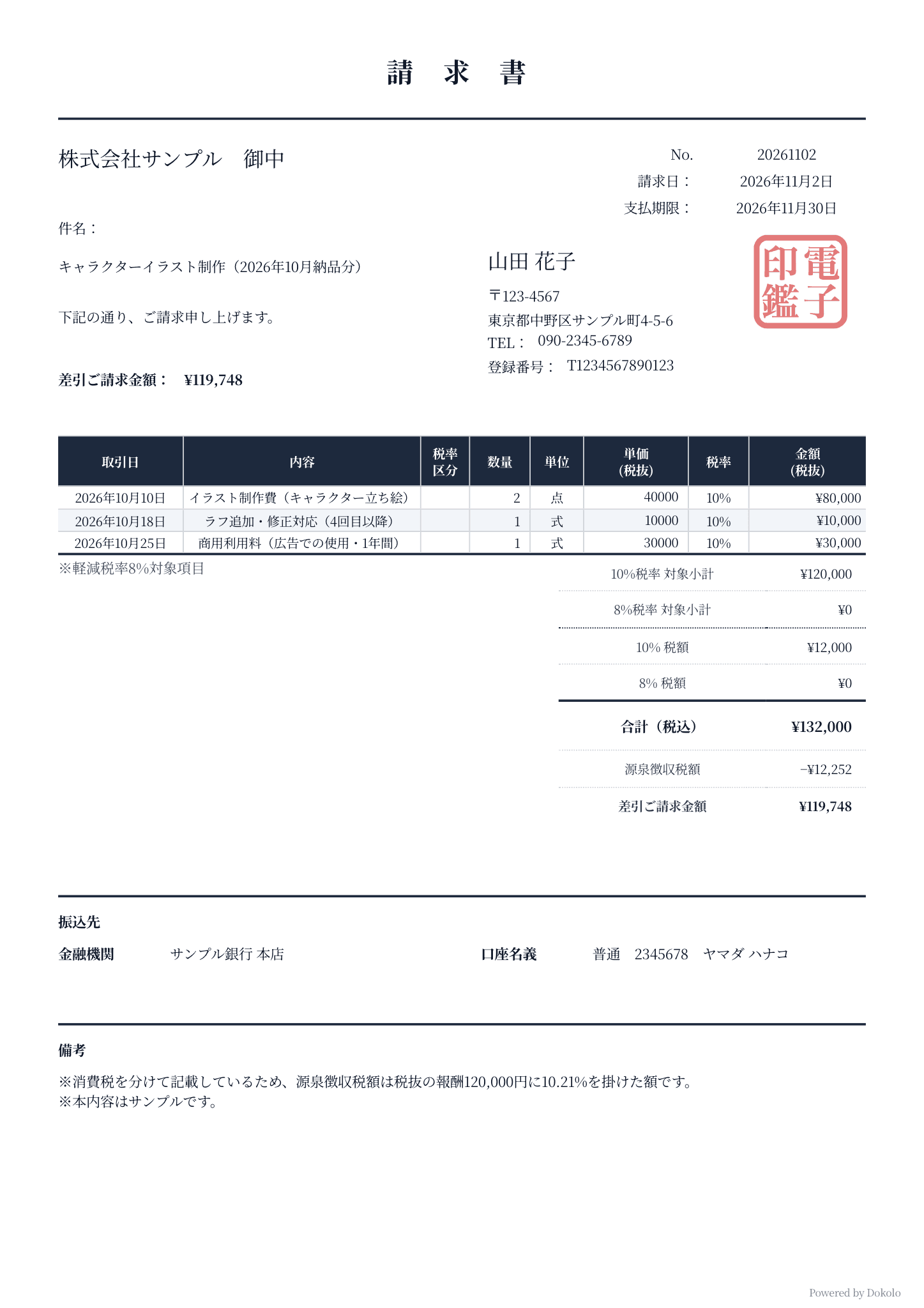
| Item (Japanese wording and meaning) | Qty | Unit price | Amount |
|---|---|---|---|
| イラスト制作費(キャラクター立ち絵) — illustration production | 2点 | ¥40,000 | ¥80,000 |
| ラフ追加・修正対応(4回目以降) — extra sketches and revisions (from the fourth round onward) | 1式 | ¥10,000 | ¥10,000 |
| 商用利用料(広告での使用・1年間) — commercial-use fee (advertising use for one year) | 1式 | ¥30,000 | ¥30,000 |
| Subtotal (before tax) | ¥120,000 | ||
| Consumption tax (10%) | ¥12,000 | ||
| Total (tax included) | ¥132,000 | ||
| Withholding tax | −¥12,252 | ||
| Net amount due (差引ご請求金額) | ¥119,748 |
The withholding is 10.21% of the ¥120,000 fee, calculated without consumption tax because the tax is shown separately[12][22]. The rate above ¥1,000,000 and the rounding rule are covered in Withholding tax on invoices in Japan. Non-residents should not use this 10.21% example.
- Quantity and unit price: listing the number of pieces and a unit price, rather than a lump sum (一式), gives you a basis for pricing follow-up orders.
- Stock assets and fonts: anything in the nature of your fee is subject to withholding even if billed as "materials" (材料費)[15]. If you list such costs separately, agree with the client whether they can be left out of withholding.
Can you bill without consumption tax?
A tax-exempt business that has not registered for the invoice system cannot issue qualified invoices, but it can still issue ordinary invoices without a registration number[23]. You can bill the amount without a consumption tax line. According to the NTA, showing an amount equivalent to consumption tax is generally not penalized as long as the invoice could not be mistaken for a qualified invoice; writing a number that resembles a registration number is prohibited[23]. Whether to register is covered in Japan’s qualified invoice system. If you live outside Japan, see the box for overseas businesses in the registration section of the same guide.
Putting the invoice together
- Check whether you are a tax resident of Japan. If not, work out the rate using Korea-to-Japan withholding tax: work fees and royalties.
- If you are a resident, check whether the client is a company, an individual who pays salaries, or another individual, and confirm whether it will withhold.
- Decide which name goes in the issuer field (legal name or pen name), whether to show your address, and which bank account to use.
- Split the items into production, revisions, usage fees and so on, and decide whether to show consumption tax.
- If tax is withheld, check the amount and the net amount due with the withholding tax calculator.
FAQ
Do I need an invoice for a commission from a private individual in Japan?
The duty to issue a qualified invoice arises only when a registered business is asked for one by a client that is itself a taxable business. It does not extend to a private individual who is not in business[9]. Sending an invoice anyway helps avoid misunderstandings about the amount, due date and bank details. If the client asks for a receipt after paying, give one[24].
Will registering for the invoice system make my legal name or address public?
The public website lists your name with your registration number. That is your legal name, but you can ask for it to be published as an alias recorded on your residence record (for foreign residents) or as a former surname. A sole proprietor's main trade name (主たる屋号) and main office location are published only on request, except that an overseas business that is not a specified overseas business has the location of its office for transactions in Japan published in any case[18].
If I bill without consumption tax, what amount is withholding based on?
If you do not charge consumption tax, withholding is based on the fee you bill. If you show an amount for consumption tax, the client can calculate withholding on the fee alone as long as the fee and the tax are clearly separated, even on an invoice from an unregistered business[22]. This applies to residents of Japan.
Sources
- [1]
Income Tax Act, Articles 2, 183, 184, 204 and 225 (e-Gov)
e-Gov Legal Search, current law (checked November 7, 2026)Primary source
- [2]
NTA interpretive Q&A — Fees paid to copywriters, illustrators and lettering artists
Laws, regulations and circulars as of August 1, 2025 (checked November 7, 2026)Primary source
- [3]
NTA No. 2502 — Who is a withholding agent?
Laws and related provisions as of April 1, 2026Primary source
- [4]
NTA No. 2878 — Scope of Japan-source income
Laws and related provisions as of April 1, 2026Primary source
- [5]
NTA No. 2884 — Withholding and tax rates for non-residents and foreign companies
Laws and related provisions as of April 1, 2026Primary source
- [6]
National Tax Tribunal ruling of December 11, 2009 — Case Reports No. 78, p. 208
Checked October 20, 2026Primary source
- [7]
NTA Invoice System Q&A, Q55 — Using a trade name (屋号) on a qualified invoice
Revised October 2023 (checked November 7, 2026)Primary source
- [8]
e-Gov Legal Search, current law (checked November 7, 2026)Primary source
- [9]
Consumption Tax Act, Article 57-4(1) — Obligations of qualified invoice issuers (e-Gov)
e-Gov Legal Search, current law (checked November 7, 2026)Primary source
- [10]
NTA No. 6625 — Required information on qualified invoices and related documents
Laws and related provisions as of April 1, 2026 (checked November 7, 2026)Primary source
- [11]
MUFG Bank — Points to note when requesting an international transfer
Checked November 7, 2026 (MUFG Bank transfer guidance)Primary source
- [12]
NTA No. 2795 — Payments for manuscripts, lectures and similar fees
Laws and related provisions as of April 1, 2026Primary source
- [13]
Laws and related provisions as of April 1, 2026 (checked November 7, 2026)Primary source
- [14]
NTA No. 2793 — Withholding agents for fees and charges
Laws and related provisions as of April 1, 2026Primary source
- [15]
Income Tax Basic Circular (checked November 7, 2026)Primary source
- [16]
NTA No. 2792 — Fees and charges subject to withholding
Laws and related provisions as of April 1, 2026Primary source
- [17]
NTA Income Tax Basic Circulars 204-6 to 204-10 — Manuscript fees and the scope of design
Income Tax Basic Circular (checked November 7, 2026)Primary source
- [18]
NTA Invoice System Q&A, Q19 — Public registration website
Revised October 2023 (checked November 7, 2026)Primary source
- [19]
Revised June 2025 (checked November 7, 2026)Primary source
- [20]
Revised April 2026 (checked November 7, 2026)Primary source
- [21]
freee — How to write an invoice: required information and preparation
Updated June 26, 2024 (business practice; secondary source)
- [22]
NTA — Withholding on fees and charges after the invoice system begins
Published December 9, 2021 (checked October 23, 2026)Primary source
- [23]
NTA Invoice System Q&A, Q26-2 — Invoices issued by tax-exempt businesses
Revised April 2026 (checked November 7, 2026)Primary source
- [24]
Civil Code, Article 486 — Requesting a receipt
e-Gov Legal Search, current law (checked October 19, 2026)Primary source
Last verified