

Invoicing as a Photographer in Japan: When Withholding Applies
For freelance photographers billing Japanese clients, whether you live in Japan or abroad. Whether the client withholds income tax (源泉徴収) from your fee depends on what the photos are used for (print, web or video) and who pays you (a company, a sole proprietor who pays salaries, or a private customer). This page separates what Japanese law and the National Tax Agency (NTA) say from the cases the law does not spell out, where we give the treatment Japanese tax accountants describe in practice. It also gives a message you can send the client and shows how to word the invoice. Based on NTA and e-Gov sources and commentary by tax accountants, checked up to November 8, 2026.
- Last verified
- 21 sources
- 16 min read
Who this is forIndividual photographers (freelancers and sole proprietors) paid by clients in Japan. The first section splits the rules for tax residents of Japan and for non-residents; the rest of the page assumes you are a tax resident. Fees received through your own Japanese corporation are not subject to withholding, and invoicing as a company is not covered here.
Short answer
- If you are a tax resident of Japan, the photo fees Japanese law lists for withholding are fees for "photographs to be published in magazines, advertisements or other printed matter". When a company, or a sole proprietor who pays salaries, pays such a fee, it deducts 10.21% on each payment up to ¥1,000,000 and 20.42% on any part above it[1][2][3].
- For photos used only on websites, social media or online shops, the law has no express rule, but most Japanese tax accountants who address the point treat them as not subject to withholding, because the statutory list is limited to photos "to be published in … printed matter". This is a practice view, not an NTA ruling. If the photos also go into print, or you bill a separate copyright license fee, that part is covered[1][4][5].
- Filming for movies and TV programs is covered separately, as a fee for "direction" of films, plays and broadcasts. Filming web video, such as YouTube or corporate promotional videos, has no express rule; because the list is limited to films, plays and broadcasts, practitioners mostly treat it as not subject to withholding (a practice view, not a statutory rule)[6][1][2][7][8].
- If you are a non-resident for Japanese tax purposes, different rules apply: work done outside Japan and payments for using or acquiring your copyright are treated differently. Start with the first section[9][10].
No sign-in needed to fill it in and download the PDF.
On this pageWhat decides withholding: how the photos are used and who pays
What decides withholding: how the photos are used and who pays
If you live in Japan
If you are a tax resident of Japan, for example a foreign photographer based in Tokyo or Osaka, the tables below show whether tax is withheld from your fee. Where it is, the rate is 10.21% on each payment up to ¥1,000,000 and 20.42% on any part above it, with fractions of a yen dropped[6][3]. The rest of this page assumes this case.
If you live outside Japan (e.g. Korea)
Non-residents for Japanese tax purposes (no domicile in Japan and no residence there for a year or more) follow different rules[6]. Pay for personal services is Japan-source income only when it arises from services performed in Japan, so a fee purely for a shoot done outside Japan is not, by itself, Japan-source income[9]. A payment for licensing or transferring the copyright in your photos, made by a client doing business in Japan and relating to that business, is generally withheld at 20.42%, which a tax treaty may reduce[9][10]. If you come to Japan for the shoot, an individual's fee is generally withheld at a flat 20.42%, with no ¥1,000,000 tier, unless a treaty reduces or removes it[9][10]. To work out which applies to your contract, see Korea-to-Japan Withholding Tax, which explains the rules for people resident in Korea.
Article 204(1)(i) of Japan's Income Tax Act lists the fees subject to withholding, and Article 320(1) of its Enforcement Order adds fees for "photographs to be published in magazines, advertisements or other printed matter" (雑誌、広告その他の印刷物に掲載するための写真)[6][1]. That is the only photo fee the Act and the Order list, and the NTA's withholding handbook (源泉徴収のあらまし) uses the same words in its table[2]. Video falls under a different item: fees for "direction" of films, plays and radio or TV broadcasts (Article 204(1)(v) of the Act) include filming[6][1][2].
The table shows how each use is treated when a company or similar business hires you. Rows marked "No, in practice" have no express rule in the law; they show how Japanese tax accountants treat them in practice. Rows marked "Not covered by the sources" are cases where we found no answer in either NTA material or commentary by practitioners, so you check them with the client. "The sources we checked" here means Article 204 of the Income Tax Act and Article 320 of its Enforcement Order, Basic Circulars 204-6 to 204-10, the NTA's interpretive Q&A cases on fees, and Chapter 5 of the 2026 withholding handbook[11][12][2].
| Use | Withholding | Basis / what to check |
|---|---|---|
| Magazines, ads, catalogs, brochures, flyers, posters and other printed matter | Yes | These are photographs "to be published in … printed matter"[1][2] |
| Both printed matter and the web (for example, a hotel brochure and its website) | Yes | The photos are meant for print, so the row above applies. One tax accountant writes that if the invoice does not split the web and print amounts, the whole fee is withheld on, and if it does, only the print part is (a single practitioner's view; NTA material sets no such rule)[1][4] |
| Websites, social media or online shops only | No, in practice | No express rule in the law, but because the list is limited to print, most tax accountants who address it treat these photos as not covered (next section)[1][4][5] |
| Record shots of an event or ceremony for a company or organization | Depends on use | In practice the same use test applies. A tax accountant has answered that event photos used in printed matter are covered; if they are only posted online or kept as a record, the web-only row applies[13][4] |
| An in-house newsletter (社内報) | Not covered by the sources | We found neither NTA material nor practitioner commentary on company newsletters. Check with the client whether a printed newsletter counts as "other printed matter"[1] |
| Wedding or event shoots subcontracted by a wedding venue or photo studio (album or digital delivery) | Not covered by the sources | We found no source or commentary on whether photos for an album are "to be published in … printed matter". Check with the client[1] |
| Filming for movies or TV programs | Yes | Fees for "direction" include filming[6][1][2] |
| Web video, such as YouTube or corporate promotional videos | No (practice view) | The law does not define "film" and the NTA gives no example, but most tax accountants' answers and practice guides treat it as not subject because it is not on the list[1][7][8] |
| Licensing photos you have already taken | Can be covered | Copyright royalties are listed without any limit on the medium (see "Licensing photos you have already taken")[6][2] |
Even for a covered use, whether tax is actually withheld depends on who pays you.
| Who pays / how you are paid | Withholding |
|---|---|
| A company (publisher, ad agency, hotel, manufacturer) or other corporation, or a government office | Yes, for a covered use[6][14] |
| A sole proprietor who pays salaries to staff or to a family member (青色事業専従者), such as an individually run photo studio | Yes, for a covered use[15] |
| An individual who pays no salaries, such as a couple booking you for their wedding or a family portrait | No, even for print or film use[6][14] |
| You receive the fee through your own company (a Japanese domestic corporation) | No[16] |
There is no minimum amount. The rule letting payers skip withholding on payments of roughly ¥50,000 or less covers prize money for contest winners and fees for news photos and similar contributions sent to newspapers or magazines without being requested. Work the client asked for in advance is excluded, so a small commissioned shoot is still covered[6][12].
Web-only photos: not withheld in practice, with three exceptions
For photos used only on a website, social media or an online shop, Japanese law has no express rule, but most tax accountants who address the point treat the shooting fee as not subject to withholding. Their reasoning: only fees on the statutory list are withheld, the photo fees listed are for "photographs to be published in magazines, advertisements or other printed matter", and publishing online is not printed matter[1][4][5]. We found no tax accountant reaching the opposite conclusion. This is a practice view, not a treatment set by an NTA circular or Q&A. This section assumes you are a tax resident of Japan.
- What NTA material confirms: in an NTA interpretive Q&A, the fee paid to the photographer for taking photos for a CD promotion poster and jacket is treated as a "fee for photographs"[17]. The NTA's interpretive Q&A cases on fees (the full text of all 16), Basic Circulars 204-6 to 204-10 and Chapter 5 of the 2026 withholding handbook say nothing about photos used only online[11][12][2].
- Exception (1): if the photos are also used in print, such as a brochure, flyer or company profile, they are covered. One practitioner notes that if the invoice does not split the web and print amounts, the whole fee is withheld on[4].
- Exception (2): if you bill a separate fee for licensing the photos (a copyright royalty), that part can be covered whatever the medium (see "Licensing photos you have already taken")[6][2].
- Exception (3): filming for movies or TV is covered separately, as a fee for "direction"[1][5].
The duty to decide on withholding and pay the tax is the client's[6]. Some clients withhold "just to be safe". But tax deducted from a fee that did not require withholding cannot be credited or refunded through your own final tax return in Japan; to get it back you have to claim it from the client[18]. So for a web-only job, tell the client how the photos will be used and why they are treated as not covered, and agree before you invoice that no tax will be withheld.
Sample email to the client (in Japanese, ready to send)
○○株式会社 ○○様

お世話になっております。○月○日の撮影について、請求書を作る前に2点確認させてください。

1. 納品する写真は、御社Webサイトとオンラインショップへの掲載だけに使い、カタログなどの印刷物には使わない予定でよろしいでしょうか。
2. 源泉徴収の対象として法令(所得税法施行令320条1項)が挙げる写真は「印刷物に掲載するための写真」で、Web掲載だけの撮影料は対象外として扱うのが実務上の一般的な扱いとされています。この用途であれば、源泉徴収をしない請求書を作成してよろしいでしょうか。
In English: the email asks (1) whether the photos will be used only on the client's website and online shop and not in printed matter such as catalogs, and (2) notes that the photos listed for withholding in Article 320(1) of the Enforcement Order are those "to be published in printed matter", that web-only shooting fees are generally treated as not covered in practice, and asks whether you may issue the invoice without withholding.
Billing hair, makeup, styling or model fees together with yours
An NTA interpretive Q&A says that for a poster or CD-jacket shoot, the fee for a stylist or hair-and-makeup artist is not a "fee for photographs", so nothing is withheld when it is paid to that person. If the same amount is included in the photography fee and paid to the photographer, tax must be withheld from it[17].
So if you fold the makeup artist's fee into your shooting fee, it becomes part of the amount withheld on. The Q&A does not say whether listing it on a separate line of your invoice changes that. If you want it outside the withholding base, ask whether the client can pay the stylist or makeup artist directly[17].
Makeup (美粧) for films, plays or TV broadcasts is covered even when paid to the artist directly[17][1]. Model fees are also listed, as fees for the model's own work under Article 204(1)(iv), including people paid to appear in printed matter. The sources we checked do not say how a model fee is treated when you collect it and bill it yourself, so confirm with the client[6][1].
Licensing photos you have already taken
Article 204(1)(i) also lists copyright royalties. The NTA handbook describes these as payments for reproduction, performance, broadcasting, exhibition, screening, translation, arrangement, adaptation, film adaptation or other use of a copyrighted work, or for setting a publishing right[6][2]. There is no print-or-web limit, so a fee for licensing existing photos, for example stock or archive images, can be subject to withholding even when the client uses them only online.
For a new commission, the sources we checked give no rule for splitting the shooting fee into a fee for the work and a fee for the license. How a transfer (buyout, 買取り) of your copyright is treated is also unconfirmed. If your contract sets out usage rights or who owns the copyright, agree the withholding treatment with the client at the same time.
Writing the invoice: put the use in the line description
Because withholding depends on how the photos are used, say what each set of photos is for in the line description. It helps the client's accounting staff check the withholding treatment and avoids crossed wires. If the client's accounting staff work in Japanese, Japanese descriptions are easier for them to check:
- 撮影料(○○社 2027年春カタログ用・印刷物掲載) — Shooting fee (client's spring 2027 catalog, for print)
- 撮影料(Webサイト・ECサイト掲載用) — Shooting fee (for the website and online shop)
- スタジオ代(実費)、機材レンタル代(実費) — Studio and equipment rental (actual cost)
- 交通費(実費) — Travel (actual cost)
Travel costs you pay yourself and bill to the client are in principle part of the fee withheld on. They stay outside it when the client pays the transport company or hotel directly and the amount is within what is normally needed[3][19]. Studio and equipment costs are covered whatever they are called if they are really part of your fee. Whether they can be treated as a pure reimbursement of money you paid on the client's behalf is something to confirm with the client[19].
In the example below, a photographer who is a tax resident of Japan bills a hotel for brochure photos and for extra photos used only on its booking site, on one invoice. The web-only photos are left out of withholding, following the practice treatment of web-only photos, and no consumption tax is added.
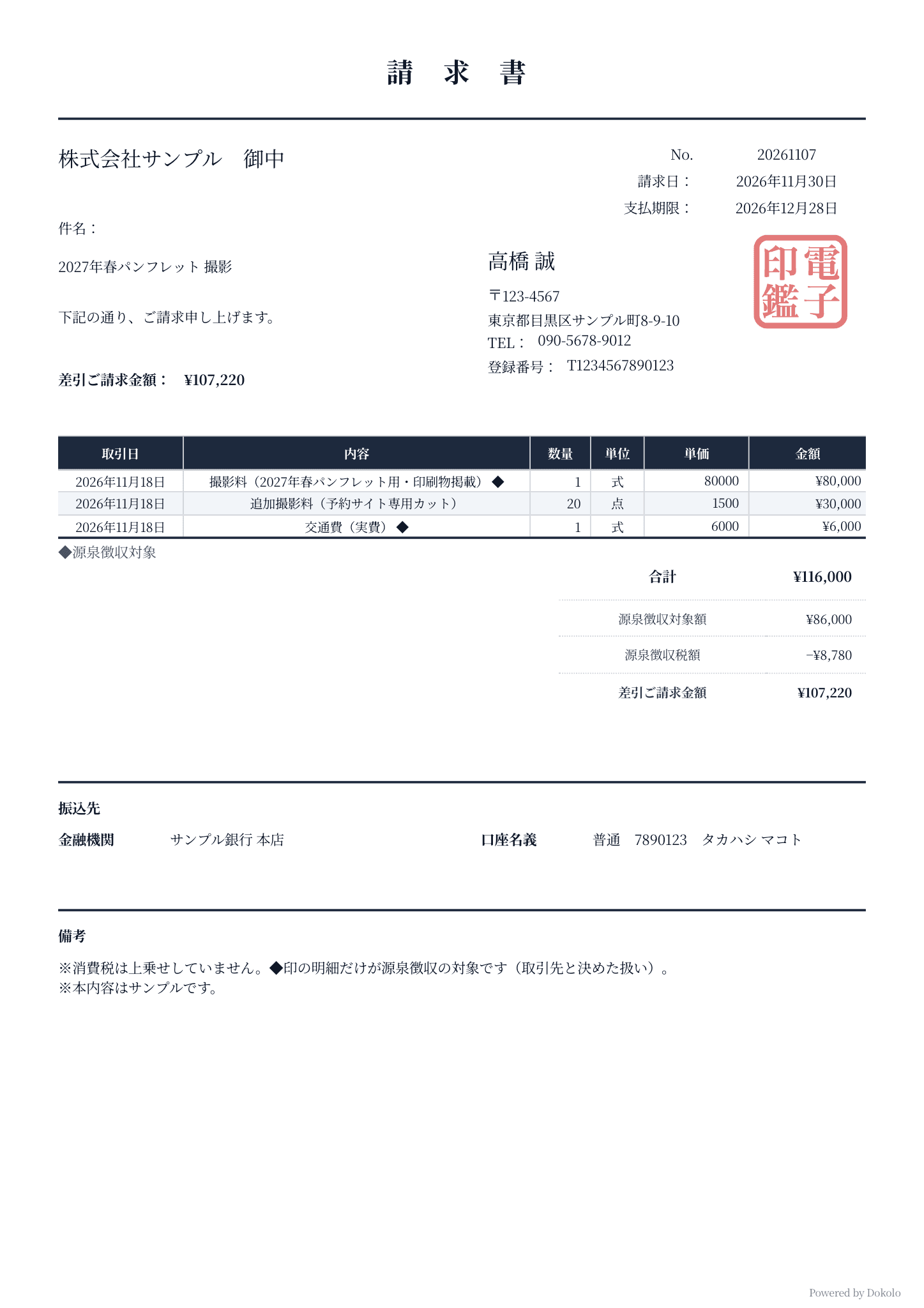
| Line | Amount | Withholding |
|---|---|---|
| 撮影料(2027年春パンフレット用・印刷物掲載) — Brochure shoot, for print | ¥80,000 | Yes |
| 追加撮影料(予約サイト専用カット・20点) — 20 extra photos for the booking site only | ¥30,000 | No (web-only, practice treatment)[4] |
| 交通費(実費) — Travel, actual cost | ¥6,000 | Yes, in principle[3] |
| 合計 — Total | ¥116,000 | |
| 源泉徴収税額 — Withholding tax | −¥8,780 | (¥80,000 + ¥6,000) × 10.21% = ¥8,780.6, fraction dropped[3] |
| 差引ご請求金額 — Net amount due | ¥107,220 | ¥116,000 − ¥8,780 |
If the client withholds on every line just to be safe, the withholding tax is ¥116,000 × 10.21% = ¥11,843 (fraction dropped) and the net amount due is ¥104,157[3]. The extra ¥3,063 on the web-only photos cannot be settled through your tax return and has to be recovered from the client, so agree the treatment before you send the invoice[18].
If you add consumption tax, show the fee and the tax separately; the client may then withhold on the fee alone. Otherwise the tax-inclusive amount is the base[3][20]. See Withholding Tax on Invoices in Japan for a worked example, and How to Write an Invoice in Japan for the other items on an invoice.
FAQ
The photos are only for the web, but the client says it will withhold tax. Can I refuse?
You can explain the basis and ask the client not to withhold. The law has no express rule, but because the statutory list is limited to photos for printed matter, most Japanese tax accountants treat web-only shooting fees as not subject to withholding[1][4][5]. The decision and the duty to pay the tax are still the client's[6], and if the photos will also go into a catalog or other print, they are covered. If you are a tax resident of Japan, tax deducted when no withholding was required cannot be settled through your final tax return (確定申告); you would have to claim it back from the client directly[21][18]. So agree the treatment before you invoice.
Do I show withholding tax on an invoice to a couple whose wedding I photographed?
No. Nothing is withheld from a fee paid by an individual who pays no salaries, so bill the full fee[6][14]. If a wedding venue or photo studio subcontracted the shoot to you, the payer is a business; check the wedding row in the first table with the client. If you file a final tax return in Japan, include fees that were not withheld on along with your other income[21].
The client wants both photos and video from one job. How do I invoice it?
Put the photography fee and the video fee on separate lines. For photos, withholding depends on print or web use; for video, it depends on whether the footage is for a film or TV program or for the web. A single "shooting services" (撮影一式) line leaves the client unable to tell what to withhold on. Filming for movies or TV is covered[1][2]; web video is mostly treated as not subject in practice[7][8]. Separate lines let the client decide line by line.
Sources
- [1]
Order for Enforcement of the Income Tax Act, Article 320(1), (3) and (4) (e-Gov)
e-Gov Legal Search, current law in force from May 22, 2026 (checked November 8, 2026)Primary source
- [2]
NTA, Outline of Withholding Tax 2026 (源泉徴収のあらまし), Chapter 5: Withholding on fees and charges (PDF)
Based on laws as of September 1, 2025 (checked November 7, 2026)Primary source
- [3]
NTA No. 2795 — Payments for manuscripts, lectures and similar fees
Laws and related provisions as of April 1, 2026Primary source
- [4]
Published April 22, 2026, updated September 2 (practice view; secondary source; checked November 8, 2026)
- [5]
Information as of publication on August 23, 2018 (practice view; secondary source; checked November 8, 2026)
- [6]
Income Tax Act, Articles 2, 204 and 205 (e-Gov)
e-Gov Legal Search, current law (checked November 7, 2026)Primary source
- [7]
Information as of publication on August 23, 2018 (practice view; secondary source; checked November 8, 2026)
- [8]
Money Forward Cloud Invoice — How video creators should write invoices
Updated October 22, 2024 (practice view; secondary source; checked November 8, 2026)
- [9]
NTA No. 2878 — Scope of Japan-source income
Laws and related provisions as of April 1, 2026Primary source
- [10]
NTA No. 2884 — Withholding and tax rates for non-residents and foreign companies
Laws and related provisions as of April 1, 2026Primary source
- [11]
NTA interpretive Q&A cases, withholding income tax index — fees and charges
Checked November 7, 2026Primary source
- [12]
Income Tax Basic Circular (checked November 7, 2026)Primary source
- [13]
Zeirishi.com tax Q&A — “On the obligation to withhold” (answer by tax accountant Yonemori Matsumi)
Information as of publication on October 18, 2024 (practice view; secondary source; checked November 8, 2026)
- [14]
NTA No. 2502 — Who is a withholding agent?
Laws and related provisions as of April 1, 2026Primary source
- [15]
NTA No. 2793 — Withholding agents for fees and charges
Laws and related provisions as of April 1, 2026Primary source
- [16]
NTA No. 2792 — Fees and charges subject to withholding
Laws and related provisions as of April 1, 2026Primary source
- [17]
NTA interpretive Q&A — Stylist and hair-and-makeup fees
Laws, regulations and circulars as of August 1, 2025 (checked November 8, 2026)Primary source
- [18]
National Tax Tribunal ruling of November 27, 2006 — Case Reports No. 72, p. 246
Checked November 8, 2026Primary source
- [19]
Income Tax Basic Circular (checked November 7, 2026)Primary source
- [20]
NTA — Withholding on fees and charges after the invoice system begins
Published December 9, 2021 (checked November 7, 2026)Primary source
- [21]
NTA No. 2020 — Final income tax returns
Laws and related provisions as of April 1, 2026Primary source
Last verified