

Invoicing for Video Editing in Japan: Is Tax Withheld?
For freelance video editors working for Japanese clients: which video work Japanese tax law names as subject to withholding tax, and which work (YouTube and corporate web videos) the law does not address, where practice decides. Japanese tax accountants' published answers mostly treat that work as outside withholding, though some clients withhold anyway to be safe. The page covers how to agree the treatment before you invoice and how to show it, based on National Tax Agency (NTA) and e-Gov sources and practitioner commentary checked on November 8, 2026.
- Last verified
- 21 sources
- 14 min read
Who this is forIndividuals who edit, shoot or make captions for videos as independent contractors for Japanese clients. Most of the page assumes you are a tax resident of Japan; the first box and the section on editing from outside Japan cover what changes if you are a non-resident for Japanese tax purposes. Tax is not withheld from fees received through your own Japanese corporation.
Short answer
- Japan's list of fees subject to withholding tax (源泉徴収) has no entry for "video editing". What it does name is editing, filming and production for films and plays, and design work such as on-screen text graphics (テロップ, "telop") for TV broadcasts. When a company or other organization pays a tax resident of Japan for this work, it deducts 10.21% on each payment up to ¥1,000,000 and 20.42% on any part above it[1][2][3][4].
- Editing for films and TV programmes is subject to withholding. Editing YouTube, social media or corporate videos is not addressed in the law, but Japanese tax accountants who answered for that medium have treated it as outside withholding because it is not on the list. That is a practice view, not a statutory rule, and some corporate clients withhold anyway to be safe[2][5][6]. If you are a tax resident of Japan, tax deducted from a fee that did not require withholding cannot be credited in your final return; you have to recover it from the client. So share the basis before you invoice and agree that nothing will be withheld[7]. Caption and thumbnail lines can still be covered separately as design fees[3].
- If you are a tax resident of Japan and the client is an individual who pays no salaries, such as a YouTuber working alone, nothing is withheld whatever the video is[1][8].
No sign-in needed to fill it in and download the PDF.
On this pageVideo work that Japanese law lists for withholding
Video work that Japanese law lists for withholding
If you live in Japan
For tax residents of Japan, the work in the table below is subject to withholding at 10.21% on each payment up to ¥1,000,000 and 20.42% on any part above it[1][4]. The rest of this page assumes this case.
If you live outside Japan (e.g. Korea)
Non-residents for Japanese tax purposes (no domicile in Japan and no residence there for a year or more) follow different rules[1]. Pay for personal services is Japan-source income only when it arises from services performed in Japan, so tax is generally not withheld from fees for editing done abroad and delivered as a file; copyright royalties and payments for transferring copyright are assessed separately[9]. See "Editing from outside Japan" below.
Only fees listed in Article 204(1) of the Income Tax Act and Article 320 of its Enforcement Order are subject to withholding[1][2]. Two categories matter for video work. Item 5 covers fees for appearing in, directing or planning films, plays and radio or TV broadcasts, and Article 320(4) of the Order says "direction" includes 「映画若しくは演劇の製作、…撮影、…編集、美粧又は考証」, that is, production, filming, editing, makeup and period research for films or plays[1][2]. Item 1 covers design fees, among others.
The table lists the work that NTA circulars and Q&As name as covered. If the client is a withholding agent and your job is on it, the fee is subject to withholding. One exception: the fee paid to a producer commissioned to make a film is not an item 5 fee (Basic Circular 204-28-3, covered in the next section)[10].
| Work | Category | Source |
|---|---|---|
| Editing, filming or production for a film or play | Direction of films and plays (item 5) | Enforcement Order Art. 320(4)[2][11] |
| Supervision fees (cut fees) and music selection fees for films or plays | Production and editing of films and plays (item 5) | Basic Circular 204-26[10] |
| Making the text graphics (telop) shown in TV broadcasts | Design fee (item 1) | NTA Q&A on telop fees[3] |
| Original drawings, line drawings and title cards for films; pattern graphics for TV broadcasts | Design fee (item 1) | Table in Basic Circular 204-6[12] |
| Recording narration for film | Recording fee (item 1) | Table in Basic Circular 204-6[12] |
| Film synopses, scripts and script adaptation | Manuscript, script and adaptation fees (item 1) | Table in Basic Circular 204-6; Enforcement Order Art. 320(1)[12][2] |
Whether tax is withheld from fees for editing or filming a TV programme depends on whether the work is "direction relating to TV broadcasting" under item 5. For makeup, which is on the same list, the NTA says tax must be withheld when it is paid as a makeup fee for films, plays or TV broadcasts[13]. None of the circulars or Q&As checked uses TV programme editing itself as an example. In practice, though, tax accountants' published answers treat filming and editing for films, plays and TV broadcasts as covered, and they agree on this[5][6]. Invoice programme editing for a broadcaster or production company on the basis that tax will be withheld.
Item 5 fees are withheld at the same rates as item 1 fees: 10.21% up to ¥1,000,000 per payment and 20.42% above it[1][11]. The calculation and how payers are classified are in Withholding Tax on Invoices in Japan.
YouTube and corporate videos: not in the law, mostly treated as outside withholding in practice
Here is what Japanese law and the NTA materials checked say about online video work, and what they do not.
| Work | What the sources say | What they do not say |
|---|---|---|
| Editing or filming YouTube, social media, promotional, recruitment or webinar videos | Filming and editing for "films or plays" is subject to withholding[2] | What a "film" is (the Act and the Order do not define it). The circulars checked (204-24 to 204-28-5) and the Q&As checked give no example dealing with online video[2][10] |
| Motion graphics, captions and text graphics for online video | Design is "generally planning a practical and aesthetic form and expressing it visibly"; text graphics for TV broadcasts are design fees[3] | Whether text or animation in videos that are not TV broadcasts meets that definition. It may depend on the work |
| Producing a whole video, from planning to filming and editing | The fee paid to a producer commissioned to make a film is not an item 5 fee, even if it includes performers' fees (Basic Circular 204-28-3)[10] | Whether that circular applies when one freelancer is commissioned to produce the whole video |
Since the law and the NTA give no answer, here is how practitioners read it. A tax accountant who answered for this medium says only fees "listed in the law" are withheld, and that filming and editing are covered only for films, plays and TV broadcasts[5]. Another tax accountant answered that editing YouTube videos is outside withholding[6]. An accounting software company's guide likewise says footage for websites is considered not covered[14]. The majority practice view, then, is that editing videos for online publication is not subject to withholding. It is not a statutory rule, and in the same thread another tax accountant, without distinguishing the medium, said video editing is usually covered[6].
The treatment changes in these cases.
- Videos for TV broadcast or film: editing or filming video that will be broadcast on TV or used as a film is covered (previous section).
- Caption design and thumbnails: newly designing text or images can be a design fee under item 1, separate from the editing. Text graphics for TV broadcasts are design fees[3], and some clients withhold on these lines even for online video.
- A client who pays no salaries: if a YouTuber working alone or another individual who pays no salaries pays you, nothing is withheld, whatever the video[1][8].
Agree on withholding with your client before you invoice
First check whether the client is a withholding agent. Companies and other corporations, and sole proprietors who pay salaries, are withholding agents. An individual who pays no salaries, or pays them only to two or fewer regular household employees, does not withhold[1][8][15].
| Client or how you are paid | Withholding |
|---|---|
| A company or other corporation (production company, broadcaster, any business) | Yes, if the work is covered[8] |
| A sole proprietor who pays salaries to staff or to a family member (青色事業専従者) | Yes, if the work is covered[15] |
| An individual who pays no salaries, such as a YouTuber working alone | No[1][8] |
| You are paid through your own Japanese corporation | No[16] |
If the client is a withholding agent and the job is editing for online publication, the practice view is that nothing should be withheld, but some companies withhold anyway because they would rather not be challenged by the tax office[5]. Agree on it in this order.
- Tell the client what the video is for (TV broadcast, film, online) and what you are billing (editing, filming, captions, thumbnails). For online videos, point to the tax accountants' view that the editing fee is outside withholding and agree that it will not be withheld. Settle at the same time whether the caption and thumbnail lines are covered.
- Show the withholding tax and the net amount due on your invoice to match what you agreed. If no line is withheld, leave the withholding line off and bill the total.
- Keep the agreement in writing, by email or chat. It helps when you handle the next job the same way.
Sample message to your client (Japanese)
今回の動画編集(Web公開用・全4本)の請求書についてご相談です。Web公開用の動画編集は、源泉徴収の対象として列挙されている映画・演劇やテレビ放送の編集に当たらず、対象外とする税理士の見解が多いため、編集費は源泉徴収なしでご請求できればと考えております。テロップ・字幕制作とサムネイル制作の行を源泉徴収の対象とされるかどうかも、あわせて教えていただけますか。いただいたお答えに合わせて、請求書の差引額を記載します。
About the invoice for four online videos, the message says that editing for online publication is not the film, play or TV editing listed for withholding, that most tax accountants treat it as outside withholding, and so you would like to bill the editing fee without withholding. It also asks whether the client will withhold on the caption and thumbnail lines, and says you will set the net amount to match.
If the client still decides to withhold to be safe, invoice on that basis. But if you are a tax resident of Japan, your final tax return (確定申告) settles only tax that was correctly withheld under the law[17]. An amount deducted when no withholding was required cannot be recovered through the return; you claim it from the client directly[7]. Agreeing before anything is deducted is the safer route.
Writing the line items: one line per task
Rather than billing 「動画制作一式」 (video production, lump sum), put editing, captions, thumbnails and materials on separate lines so the client can decide line by line. Japanese clients' accounting staff check invoices in Japanese, so Japanese line descriptions help.
| Line item | What to check |
|---|---|
| 動画編集費(YouTube動画 4本) — Video editing, 4 YouTube videos | Online video: mostly treated as outside withholding in practice[6]. Follow what you agreed |
| 動画編集費(○○番組 第5回) — Editing, TV programme episode 5 | TV broadcast editing. Treated as covered in practice[5] |
| テロップ・字幕制作(4本) — Captions and text graphics | Design fee if for TV broadcast[3]. Some clients treat it as a design fee for online video too |
| サムネイル制作(4点) — Thumbnails | New image design, which can be a design fee[12]. Agree with the client whether it is covered |
| BGM・素材購入費(実費) — Music and stock footage, actual cost | Treated like the fee if it is really part of your pay, whatever it is called[18]. Check with the client whether it is a reimbursement instead |
The example below is hypothetical: an editor resident in Japan has agreed with a company that the online video editing and thumbnails are not withheld and the captions are withheld as a design fee, and does not add consumption tax.
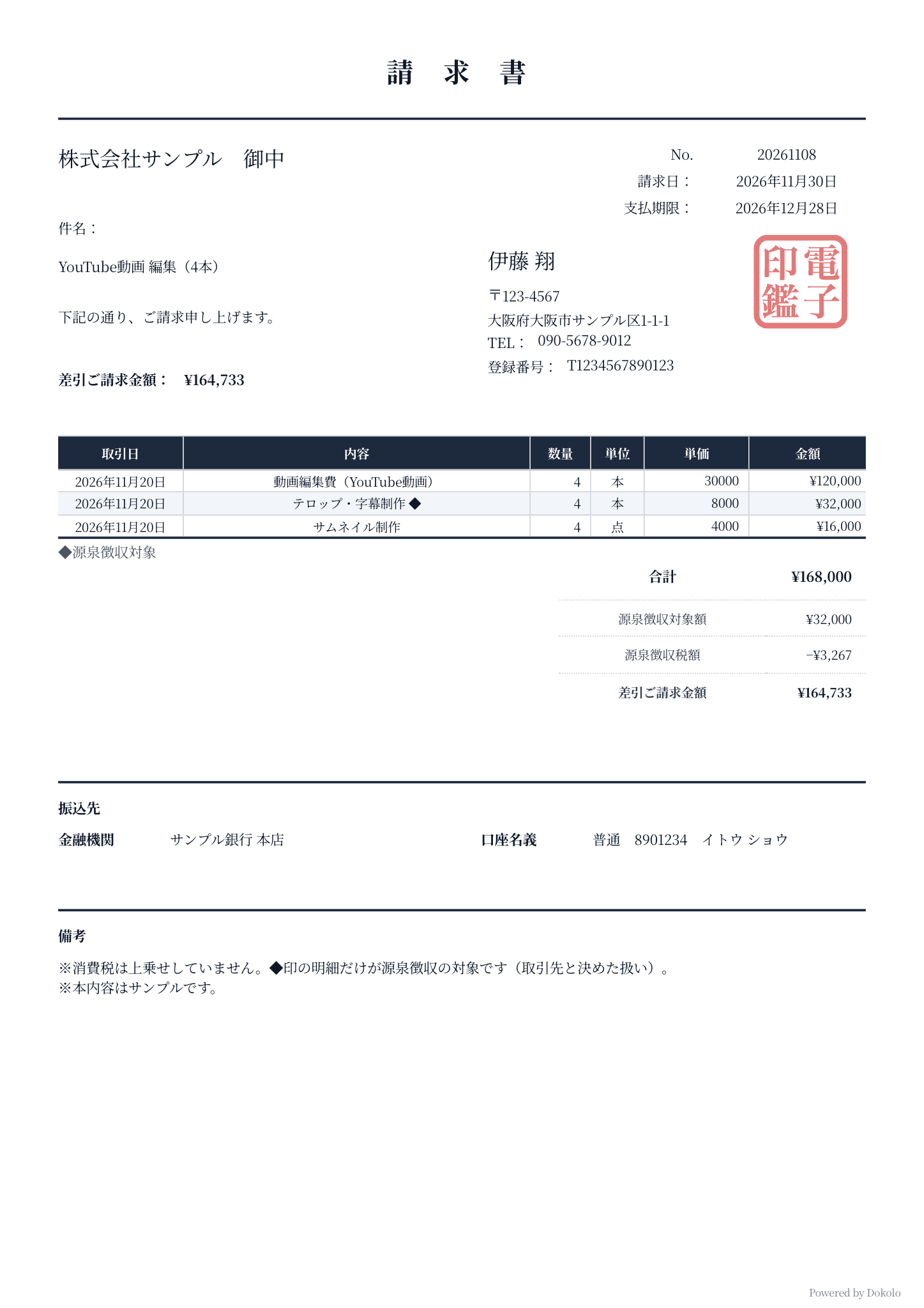
| Line | Amount | Calculation |
|---|---|---|
| 動画編集費(YouTube動画 4本) — Video editing | ¥120,000 | 4 × ¥30,000 |
| テロップ・字幕制作(4本) — Captions | ¥32,000 | 4 × ¥8,000 |
| サムネイル制作(4点) — Thumbnails | ¥16,000 | 4 × ¥4,000 |
| 合計 — Total | ¥168,000 | |
| 源泉徴収税額 — Withholding tax | −¥3,267 | ¥32,000 × 10.21% = ¥3,267.2, fraction dropped[4] |
| 差引ご請求金額 — Net amount due | ¥164,733 | ¥168,000 − ¥3,267 |
If you add consumption tax, show the fee and the tax separately; the client may then withhold on the fee alone[4][19]. See Withholding Tax on Invoices in Japan for a worked example, and How to Write an Invoice in Japan for the other items on an invoice.
Editing from outside Japan
If you are a non-resident for Japanese tax purposes, the first question is not whether the work is on the list but whether the income is Japan-source. Pay for personal services is Japan-source when it arises from services performed in Japan, so tax is generally not withheld in Japan from fees for editing you do abroad and deliver online[9].
- If you are paid for copyright: royalties or payments for transferring copyright, received from a client doing business in Japan and connected with that business, are Japan-source income, withheld at 20.42% in principle, which a tax treaty may reduce or remove[9][20]. This page does not decide whether any part of the fee for an edited video is a copyright payment. If your contract transfers or licenses copyright, check with the client how that part is treated. Korea-to-Japan Withholding Tax explains the test for people resident in Korea.
- If you come to Japan to film or edit: the work is performed in Japan, so non-resident withholding can apply[9][20].
- Japanese consumption tax: services performed outside Japan are generally outside the scope of Japanese consumption tax[21].
FAQ
A client on a crowdsourcing site asked me to untick the withholding box. What should I do?
For editing videos for online publication, you can untick it and take the job without withholding. The law has no express rule, but a tax accountant explains that YouTube video editing is outside withholding, which is why some companies ask you to leave withholding out[6]. Deciding whether to withhold, and the duty to do it, belong to the payer[1]. If the job includes work the NTA names as covered, such as text graphics for TV broadcasts, point the client to that source and discuss it[3]. Check the platform's help pages for where the setting lives, and keep your exchange with the client in the platform's messages.
Are thumbnail designs subject to withholding?
They can be. No NTA material mentions thumbnails, but newly designing an image can be a design fee under item 1. The circular introduces its design categories as examples ("there are the following") and describes graphic design as design for advertisements, posters, wrapping paper and the like[12]. Even if the editing fee is treated as outside withholding, a client may withhold on the thumbnail line. Bill thumbnails on their own line and agree how they are treated.
Sources
- [1]
Income Tax Act, Articles 2, 204 and 205 (e-Gov)
e-Gov Legal Search, current law in force from October 1, 2026 (checked November 8, 2026)Primary source
- [2]
Order for Enforcement of the Income Tax Act, Article 320(1) and (4) (e-Gov)
e-Gov Legal Search, current law in force from May 22, 2026 (checked November 8, 2026)Primary source
- [3]
NTA interpretive Q&A — Fees for TV caption (telop) graphics
Laws, regulations and circulars as of August 1, 2025Primary source
- [4]
NTA No. 2795 — Payments for manuscripts, lectures and similar fees
Laws and related provisions as of April 1, 2026Primary source
- [5]
Information as of publication on August 23, 2018 (practice view; secondary source; checked November 8, 2026)
- [6]
Information as of publication on September 2, 2020 (practice view; secondary source; checked November 8, 2026)
- [7]
National Tax Tribunal ruling of November 27, 2006 — Case Reports No. 72, p. 246
Checked November 8, 2026Primary source
- [8]
NTA No. 2502 — Who is a withholding agent?
Laws and related provisions as of April 1, 2026Primary source
- [9]
NTA No. 2878 — Scope of Japan-source income
Laws and related provisions as of April 1, 2026Primary source
- [10]
Income Tax Basic Circular (checked November 8, 2026)Primary source
- [11]
NTA Withholding Tax Guide (源泉徴収のあらまし), 2026 edition, Chapter 5 — Withholding on fees and charges
2026 edition (checked November 8, 2026)Primary source
- [12]
Income Tax Basic Circular (checked November 8, 2026)Primary source
- [13]
NTA interpretive Q&A — Stylist and hair-and-makeup fees
Laws, regulations and circulars as of August 1, 2025Primary source
- [14]
Money Forward Cloud Invoice — How video creators should write invoices
Updated October 22, 2024 (practice view; secondary source; checked November 8, 2026)
- [15]
NTA No. 2793 — Withholding agents for fees and charges
Laws and related provisions as of April 1, 2026Primary source
- [16]
NTA No. 2792 — Fees and charges subject to withholding
Laws and related provisions as of April 1, 2026Primary source
- [17]
NTA No. 2020 — Final income tax returns
Laws and related provisions as of April 1, 2026Primary source
- [18]
Income Tax Basic Circular (checked November 7, 2026)Primary source
- [19]
NTA — Withholding on fees and charges after the invoice system begins
Published December 9, 2021 (checked November 7, 2026)Primary source
- [20]
NTA No. 2884 — Withholding and tax rates for non-residents and foreign companies
Laws and related provisions as of April 1, 2026Primary source
- [21]
NTA No. 6210 — Transactions outside Japan
Laws and related provisions as of April 1, 2026Primary source
Last verified