

Invoicing as a Software Engineer in Japan: No Withholding, Monthly Billing and Line Items
For freelance software engineers billing Japanese clients: whether to show Japanese withholding tax (源泉徴収) on your invoice, what to check when a client says it will withhold, and how to write line items for fixed-price, monthly and hourly work. Residents and non-residents of Japan for tax purposes follow different rules, so the first section splits the two. Based on Japan’s Income Tax Act, its Enforcement Order, the National Tax Agency’s circulars and other NTA material checked on November 7, 2026.
- Last verified
- 18 sources
- 14 min read
Who this is forFreelance engineers and developers who contract with Japanese businesses as individuals. The main text is for residents of Japan for tax purposes; if you are a non-resident, the first section points you to the rules that apply instead.
Short answer
- If you are a resident of Japan for tax purposes, fees for programming and system development are not among the fees that Japan’s Income Tax Act (Article 204(1)) and its Enforcement Order (Article 320(1)) list as subject to withholding. If you bill only for development work, leave withholding off the invoice[1][2].
- If you are a non-resident for Japanese tax purposes, the non-resident rules apply. A fee only for work done outside Japan is not taxed at source in Japan, but payment for licensing or transferring copyright in software, made by a client doing business in Japan in connection with that business, can be withheld at 20.42%. If the beneficial owner is a resident of Korea, a treaty filing can bring this down to 10%[3][4][5][6].
- Some engineering work is on the list: speaking at seminars, teaching courses, writing technical articles, and licensing a program whose copyright you own. When the client is a company or a sole proprietor who pays salaries, tax is withheld from those line items[1][2][7].
- For monthly contracts with a settlement range of hours, put the month in the project name or transaction period, and bill the base monthly fee and any overtime or shortfall adjustment as separate lines. The range and the calculation method are set in your contract, and the invoice follows that calculation[8].
No sign-in needed to fill it in and download the PDF.
On this pageFirst: are you a resident of Japan for tax purposes?
First: are you a resident of Japan for tax purposes?
Japanese withholding works completely differently depending on whether you are a resident of Japan under its Income Tax Act. A resident is an individual who has a domicile (住所) in Japan or has had a residence (居所) there continuously for at least one year. Anyone else is a non-resident for Japanese tax purposes: no domicile in Japan and no residence there for a year or more[1]. Nationality does not matter.
If you live in Japan
If you are a resident for Japanese tax purposes, the rules on this page apply. Development fees are not on the withholding list, so nothing is withheld; you only need to check the exceptions such as lectures, writing and license fees[1][2]. Read on from the next section.
If you live outside Japan (e.g. Korea)
If you are a non-resident for Japanese tax purposes, the non-resident rules apply and the test changes. A fee only for work done outside Japan is not Japan-source income, so no Japanese tax is withheld[3]. Payment for licensing or transferring copyright, software included, received from a client doing business in Japan and relating to that business, is a royalty withheld at 20.42% under Japanese domestic law; a tax treaty can lower the rate. The Japan–Korea treaty caps tax on royalties at 10% when the beneficial owner is a resident of Korea, so the rate is 10% if the treaty form is filed through the client by the day before the first payment[3][4][5][6]. Work an individual does on a trip to Japan is in principle withheld at 20.42%[3][4]. Check the copyright clause of your development contract first, and see Korea-to-Japan Withholding Tax: Work Fees and Royalties, written for Korea residents.
Why tax is not withheld from development fees: they are not on the list
Article 204(1) of Japan’s Income Tax Act requires anyone who pays a resident, in Japan, one of the fees "listed below" to withhold income tax at payment and pay it to the government. Only the fees listed in its items, plus those added by the Enforcement Order under item 1, are covered[1][2]. These are the entries that could touch an engineer’s work:
| Provision | What is listed |
|---|---|
| Income Tax Act, Article 204(1)(i) | Fees for manuscripts, illustrations, composing music, recordings and design; broadcast appearance fees; royalties for copyright (including neighboring rights) and industrial property rights; lecture fees[1] |
| Enforcement Order, Article 320(1) | Fees for translation, interpreting, proofreading, scripts, book cover design, stenography, printing plates and photos for print media; royalties for technical rights; fees for teaching or coaching skills, sports or knowledge; investment advisory fees, among others[2] |
| Income Tax Act, Article 204(1)(ii) | Fees for the work of lawyers, tax accountants, patent attorneys, architects, professional engineers (技術士) and similar professions[1] |
Programming, system development and software development do not appear on either list[1][2]. A fee that is not listed is not subject to withholding, even when it is paid to an individual. This applies to fees for work you take on as a business. If a payment is in fact salary or wages (給与等), it falls under withholding on employment income (Income Tax Act Article 183) instead of Article 204; this page does not cover how to tell the two apart[1].
That conclusion rests on the fee being absent from the list. None of the 16 published NTA Q&A cases on fees and charges for withholding tax deals with programming or system development either (checked November 7, 2026)[9]. Because the conclusion is read from the statutory lists, check whether your contract also pays for something other than development, as described in the next section.
If you work through a Japanese company of your own, it is simpler still: the only fee paid to a Japanese company (内国法人) that is subject to withholding is horse-racing prize money paid to a company that owns racehorses[10].
Exceptions: engineering work that is subject to withholding
If you take on any of the following alongside development, that fee is on the list. Put it on its own line item, separate from the development fee.
| Example | Category | What to check |
|---|---|---|
| Speaking at a seminar, meetup or conference | Lecture fee (Income Tax Act, Article 204(1)(i))[1][11] | Calling it an honorarium (謝礼) does not change this if it is in substance a fee[12] |
| Teaching a coding course, bootcamp class or in-house training | Fee for teaching skills or knowledge (Enforcement Order, Article 320(1)). The NTA circular gives examples such as language teaching and instructor fees for qualification courses[2][11] | Whether code review or mentoring counts as teaching is not covered by the circular’s examples |
| Writing technical articles or books, or supervising a book | Manuscript fee (Article 204(1)(i)). The circular also includes editing and supervision fees for books[1][11] | Design documents or manuals delivered as part of a development project are not among the circular’s examples |
| Licensing a program whose copyright you own | Copyright royalty (Article 204(1)(i)). Computer programs are works under Japan’s Copyright Act[1][7] | The article lists royalties (使用料). How a fee for transferring the copyright outright is treated is not stated in this article or the circular’s table[11] |
| Translating documentation as a separate job | Translation fee (Enforcement Order, Article 320(1))[2] |
Whether tax is withheld from payment for work that includes UI or website design depends on whether the payment counts as a design fee. See Programming, system development and websites for how to approach it.
Even for this work, tax is withheld only by companies and by individuals such as sole proprietors who pay salaries. Tax is not withheld from a fee paid by an individual with no duty to withhold on salaries[1]. See Who withholds.
The rate is 10.21% on the first ¥1,000,000 of a single payment and 20.42% on any part above it[13]. To check an amount, use the withholding tax calculator. Travel costs you pay yourself for a talk are in principle part of the fee; reasonable costs the client pays directly to the airline, rail company or hotel can be left out[10][12].
When the client says it will withhold tax
The duty to withhold, and to pay the tax, lies with the client[1]. How you lay out the invoice does not change that, so if a client plans to take 10.21% off a development fee, check the following before you send the invoice:
- Ask which line items the client treats as which category of fee (manuscript, lecture, copyright royalty and so on).
- Read the contract or purchase order to see whether it pays for a license to use the program as well as for the development work[1].
- If it pays only for development work, point out that programming and system development are not on the lists in Income Tax Act Article 204(1) and Enforcement Order Article 320(1), and ask whether that line item can be excluded from withholding[1][2].
- If you still disagree, ask the client to check with its tax office or tax accountant. If tax has already been deducted from a payment, check what to do with the client and, if needed, a tax office or tax accountant.
You can ask with a Japanese email like the one below. In English it says: "I’d like to confirm how withholding applies to the October invoice. This was system development work, which I understand is not among the fees listed in Income Tax Act Article 204(1) and Enforcement Order Article 320(1), such as manuscripts, lectures or copyright royalties. If you consider it subject to withholding, could you tell me which category you think it falls under?"
Sample email to the client (Japanese)
〇〇株式会社
〇〇様

お世話になっております。〇〇です。
10月分のご請求について、源泉徴収のお取り扱いを確認させてください。
今回の業務はシステム開発の作業で、所得税法第204条第1項および所得税法施行令第320条第1項に列挙された報酬(原稿・講演・著作権の使用料など)には当たらないと考えております。
源泉徴収の対象とお考えの場合は、どの区分に当たるとご判断されたかをお知らせいただけますでしょうか。
どうぞよろしくお願いいたします。
Writing line items: match the contract’s job name and period
On a Japanese qualified invoice (適格請求書), a description of the transaction is one of the required items[14]. Using the job name from the contract and the period covered lets the client match your invoice to its purchase order. The examples are in Japanese, with a translation, so that staff at a Japanese client can read them and match them to the contract.
| Contract type | Line item (meaning) | Quantity and unit |
|---|---|---|
| Fixed-price work (請負, paid on delivery) | 在庫管理システム開発一式(2026年10月納品) — inventory system development, delivered October 2026 | 1 式 (lot) |
| Monthly fee (準委任, quasi-mandate) | システム開発支援業務(2026年10月分) — system development support, October 2026 | 1 式 |
| Hourly billing | アプリ開発業務(2026年10月分) — app development, October 2026 | 152 時間 (hours) × hourly rate |
| Work subject to withholding | 社内勉強会 講師料(10月15日実施) — in-house study session, instructor fee, October 15 | 1 式 |
- When one invoice covers a month of work, the transaction date can be given as a period such as 「2026年10月分」 (for October 2026)[14].
- If 「一式」 (one lot) alone does not make clear what was done, add the features or deliverables to the project name or notes.
- Keep work that is subject to withholding, such as an instructor fee, on a separate line from development. It makes clear to the client which amount the withholding applies to.
How to show Japanese consumption tax, and what changes if you are not a registered qualified invoice issuer, are covered in How to Write an Invoice in Japan and Japan’s Qualified Invoice System.
Monthly and hourly billing with a settlement range
Japanese quasi-mandate contracts (準委任) and SES contracts, where a developer works on the client’s project for a monthly fee, commonly use a settlement range (精算幅), for example "140–180 hours, ¥X per month". Within the range you are paid the monthly fee; above the upper limit the excess hours are paid extra, and below the lower limit the missing hours are deducted. That is how one Japanese accounting software company describes the practice[8]. Which range and calculation method apply is something you agree in the contract.
There are two common ways to set the hourly rates for the adjustment: dividing the monthly fee by the upper and lower limits (上下割), or by the midpoint of the range (中割), and the same source advises stating which one applies in the contract[8]. The invoice simply itemizes the calculation your contract sets.
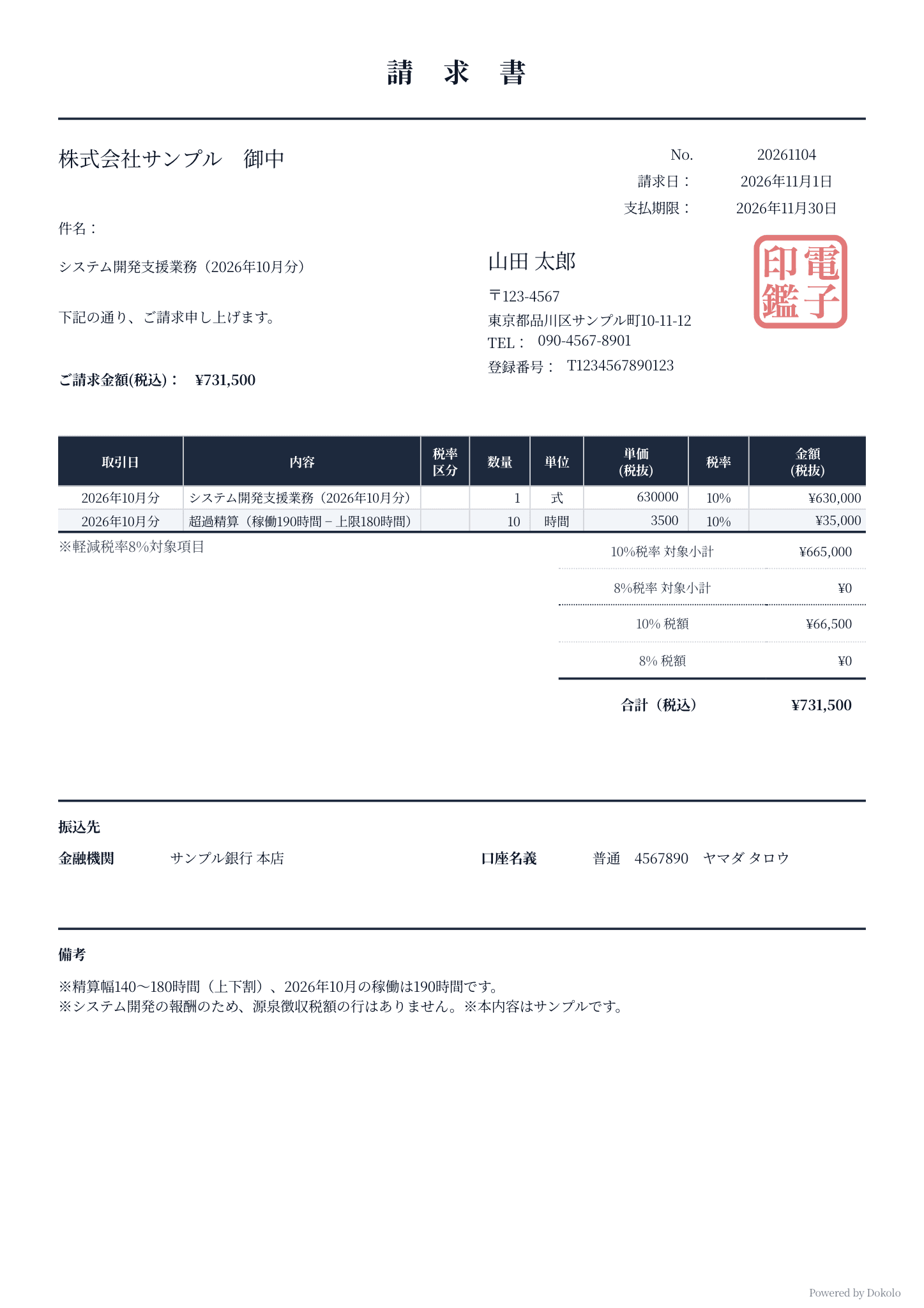
| Line item | Quantity | Unit price | Amount |
|---|---|---|---|
| システム開発支援業務(2026年10月分) — base monthly fee | 1 式 | ¥630,000 | ¥630,000 |
| 超過精算 — excess hours (190 worked − 180 upper limit) | 10 時間 | ¥3,500 | ¥35,000 |
| Subtotal (before tax) | ¥665,000 | ||
| Consumption tax (10% standard rate, assumed) | ¥66,500 | ||
| Total (tax included) | ¥731,500 |
- The ¥3,500 excess rate is the ¥630,000 monthly fee divided by the 180-hour upper limit, under the upper/lower-limit method[8].
- If you fall short, say 130 hours, the shortfall rate is ¥630,000 divided by the 140-hour lower limit, ¥4,500, so 10 missing hours mean a ¥45,000 deduction shown as 「控除精算」 (shortfall adjustment)[8].
- Write the range and the hours worked in the line item or the notes so the client can check them. Agree in the contract how to round the hourly rates.
- This invoice is for development work by a resident of Japan only, so it has no withholding line[1][2].
FAQ
Do I need to write "no withholding" on the invoice?
No. The duty to withhold the tax and pay it to the government lies with the payer[1]. When a fee is subject to withholding, showing the withholding amount on the invoice is described as common practice in Japan because it helps both sides check the amount paid[15]. For development fees paid to a resident of Japan, leave out the withholding line and bill the tax-inclusive total. If the client asks why, explain that the work is not on the list.
I have a full-time job. Do I still need an invoice for side work for a Japanese company?
You need one if the client asks for an invoice to process payment. The duty to issue a qualified invoice applies only to registered qualified invoice issuers, when a client that is a taxable business asks for one[16]. If you are not registered, that duty does not apply, and whether you send an ordinary invoice depends on what you agree with the client. Such an invoice has no registration number, and you must not show anything that could be mistaken for one, such as a similar-looking number[17]. Whether it is a side job does not change how you write the invoice or whether tax is withheld. Whether a resident of Japan needs to file a tax return for side income depends on annual income and other factors[18]. Tax in your home country, if you live abroad, is a separate question.
Sources
- [1]
Income Tax Act, Articles 2(1)(iii), 183 and 204 (e-Gov)
e-Gov Legal Search, current law (checked November 7, 2026)Primary source
- [2]
Order for Enforcement of the Income Tax Act, Article 320(1) (e-Gov)
e-Gov Legal Search, current law (checked November 7, 2026)Primary source
- [3]
NTA No. 2878 — Scope of Japan-source income
Laws and related provisions as of April 1, 2026Primary source
- [4]
NTA No. 2884 — Withholding and tax rates for non-residents and foreign companies
Laws and related provisions as of April 1, 2026Primary source
- [5]
NTA No. 2888 — Filing the Application Form for Income Tax Convention (withholding tax)
Laws and related provisions as of April 1, 2026Primary source
- [6]
Ministry of Finance — Japan–Republic of Korea tax treaty, Article 12: royalties
Treaty text PDF, Article 12(2), (3) and (5) (checked November 7, 2026)Primary source
- [7]
Copyright Act, Article 10(1)(ix) — works of computer programming (e-Gov)
e-Gov Legal Search, current law (checked November 7, 2026)Primary source
- [8]
freee — What is a settlement range? Calculation methods and cautions for freelance contracts
Published June 2, 2025 (business practice; secondary source; checked November 7, 2026)
- [9]
NTA interpretive Q&A cases, withholding income tax index — fees and charges
Checked November 7, 2026Primary source
- [10]
NTA No. 2792 — Fees and charges subject to withholding
Laws and related provisions as of April 1, 2026Primary source
- [11]
NTA Income Tax Basic Circulars 204-6 to 204-10 — Manuscript fees and the scope of design
Income Tax Basic Circular (checked November 7, 2026)Primary source
- [12]
Income Tax Basic Circular (checked November 7, 2026)Primary source
- [13]
NTA No. 2795 — Payments for manuscripts, lectures and similar fees
Laws and related provisions as of April 1, 2026Primary source
- [14]
NTA No. 6625 — Required information on qualified invoices and related documents
Laws and related provisions as of April 1, 2026Primary source
- [15]
freee — Showing withholding tax on invoices: calculation, presentation and covered fees
Updated May 26, 2026 (business practice; secondary source)
- [16]
NTA No. 6498 — The qualified invoice-based method (invoice system)
Laws and related provisions as of April 1, 2026Primary source
- [17]
NTA Invoice System Q&A, Q26-2 — Markings that could be mistaken for qualified invoices
Revised April 2026Primary source
- [18]
NTA No. 2020 — Final income tax returns
Laws and related provisions as of April 1, 2026Primary source
Last verified