

Invoicing Japanese Clients for Translation and Interpreting: Withholding Tax
For freelance translators, interpreters and proofreaders billing Japanese clients: which jobs the client withholds income tax from, which it does not, what to do with jobs the National Tax Agency (NTA) has not addressed, and what changes if you live outside Japan. Based on NTA and e-Gov sources checked on November 7 and 8, 2026.
- Last verified
- 23 sources
- 14 min read
Who this is forIndividuals who translate, interpret or proofread for Japanese clients as independent contractors, whether you are a tax resident of Japan (residency for tax purposes, not nationality) or live abroad and are a non-resident for Japanese tax purposes. Fees received through your own Japanese corporation are not subject to withholding, and invoicing as a company is not covered here.
Short answer
- If you are a tax resident of Japan, translation and interpreting fees are subject to withholding tax (源泉徴収). Article 320(1) of the Income Tax Act Enforcement Order lists translation, interpreting and proofreading (校正) without limiting the field. A translation agency, company or public body, or a sole proprietor who pays salaries to staff or a family employee (青色事業専従者), deducts 10.21% of each payment up to ¥1,000,000 and 20.42% of any part above it[1][2][3][4][5].
- If you are a non-resident for Japanese tax purposes and translate outside Japan, what the client is paying for decides it. The NTA has ruled that a fee for a translation bought outright (買取り, the client acquiring the rights) from a resident of Korea is consideration for transferring rights, is a royalty under the Japan–Korea tax treaty, and is subject to withholding at 20.42% under Japanese law, or 10% if the treaty conditions are met and the treaty form is filed[6][7][8].
- For translation contracts that are not buy-outs, the NTA materials checked for this page give no example. Ask the client how the contract treats the rights in your translation, agree whether tax is withheld and at what rate, and invoice accordingly.
- Sign language interpreting and summary captioning for deaf and hard-of-hearing people (要約筆記) are not subject to withholding, according to the NTA[9][10]. Subtitling and machine translation post-editing are generally treated as a kind of translation and subject to withholding (the law's "translation" is not limited by field, and no material addresses them individually). Reviewing another translator's work (including native-speaker checks) is also treated as subject to withholding in practice, although no law or circular names it: it is covered whether it counts as proofreading or, like the NTA example of checking a text someone else wrote, as a supervision fee (監修料) within manuscript fees[2][11][12]. For interpreter-guides, tax accountants agree that pay for guiding that includes interpreting is an interpreting fee and subject to withholding, and one answer says sightseeing guidance with no interpreting is normally outside it[13][14].
No sign-in needed to fill it in and download the PDF.
On this pageWhich translation and interpreting fees are subject to withholding
Which translation and interpreting fees are subject to withholding
If you live in Japan
If you are a tax resident of Japan (you have a domicile in Japan, or have had a residence there continuously for a year or more), translation and interpreting fees are subject to withholding at 10.21% on each payment up to ¥1,000,000 and 20.42% on any part above it, with fractions of a yen dropped[1][3]. The two tables in this section assume this case.
If you live outside Japan (e.g. Korea)
Non-residents for Japanese tax purposes (no domicile in Japan and no residence there for a year or more) are taxed in Japan only on Japan-source income, and different rules decide whether the client withholds[1][15]. The tax treatment of translation done abroad depends on what the fee pays for, such as an outright purchase of the rights, and interpreting you come to Japan to do is treated differently again. The next section covers both.
Article 204(1)(i) of Japan's Income Tax Act covers manuscript fees and other fees "specified by Cabinet Order", and Article 320(1) of the Enforcement Order includes translation (翻訳), interpreting (通訳) and proofreading (校正) among them[1][2]. The NTA's basic circular lists translation and interpreting fees and names sign language interpreting as similar but not covered[16].
The table below collects the jobs that Japanese law or NTA material expressly puts inside or outside withholding. Jobs it does not mention are in the third section.
| Work | Withholding | What the law or NTA material says |
|---|---|---|
| Translation (business, technical, publishing and so on) | Yes | Listed as 翻訳 in Article 320(1). The NTA's withholding outline (源泉徴収のあらまし) gives "translation fees" as an example. The wording does not limit the field[2][17] |
| Interpreting (business meetings, conferences, accompanying visits) | Yes | Listed as 通訳 in Article 320(1). The outline gives "interpreting fees" as an example[2][17] |
| Proofreading of books and magazines | Yes | Listed as 校正 in Article 320(1). The outline gives "fees for proofreading books, magazines and similar" as an example[2][17] |
| Royalties on a translated book | Yes | A copyright royalty under Article 204(1)(i); the outline lists book royalties (書籍の印税). Same rate as translation fees[1][17] |
| Sign language interpreting | No | The NTA says it is neither a translation nor an interpreting fee. If you are engaged only for sign language interpreting, it is not salary either[9] |
| Summary captioning (要約筆記: summarizing speech in writing for deaf and hard-of-hearing people) | No | Not interpreting, shorthand or any other listed fee. If paid under an employment contract, it is subject to withholding as salary[10] |
Even for covered work, whether tax is actually withheld depends on who pays you and how.
| Who pays / how you are paid | Withholding |
|---|---|
| A translation agency, interpreting agency or other corporation, a company, or a public body | Yes[1][4] |
| A sole proprietor who pays salaries to staff or to a family member (青色事業専従者), such as someone running a small translation office | Yes[5] |
| An individual who pays no salaries, or pays them only to no more than two regular domestic workers, such as a private person who needs a document translated | No[1][4][5] |
| You receive the fee through your own company (a Japanese domestic corporation) | No[18] |
| You are employed by the agency and paid a salary | The fee rules do not apply; the payment is treated as salary. Not covered on this page[1] |
How payers are classified and which other fees are covered is explained in Withholding Tax on Invoices in Japan.
If you live outside Japan: a buy-out translation is taxed as a royalty
The NTA has published a ruling on exactly this situation. A Japanese company asked a university professor living in Korea to translate a Japanese paper into Korean, and the contract was a buy-out: the company acquired the translation outright. The NTA said the translation is a derivative work of the original, and because the contract transferred the rights, the fee is consideration for transferring them. It is Japan-source income under Article 161(1)(xi)(b) of the Income Tax Act and a royalty under Article 12 of the Japan–Korea tax treaty, so the company must withhold tax[6].
That answer rests on the buy-out facts. For translation you do outside Japan, the treatment depends on what the fee pays for.
| Contract or work | What the law or NTA material says | Client withholding |
|---|---|---|
| A buy-out that transfers the rights in the translation | Consideration for transferring rights, treated as a royalty[6] | 20.42% under Japanese law. Under the Japan–Korea treaty, 10% if the beneficial owner is a Korean resident, the treaty conditions are met and the treaty form reaches the tax office through the client by the day before the first payment[7][8][19] |
| A licence to use your translation | A copyright royalty is Japan-source income when paid by someone doing business in Japan and connected to that business[1][15] | Same rates as above[7][19] |
| A contract with no rights clause, or one that only describes "translation work" | No NTA example in the materials checked. A tax tribunal ruling holds that what a payment is for is judged by the contract's purpose and content, not only its label[20] | Confirm with the client |
| Interpreting you travel to Japan to do | Pay for personal services performed in Japan is Japan-source income[15] | For an individual, generally a flat 20.42% with no ¥1,000,000 tier, unless a tax treaty reduces or removes it[7] |
| Remote interpreting you do online from abroad | Pay for personal services is Japan-source income when it arises from services performed in Japan[15]. No NTA material checked addresses joining a meeting in Japan online from abroad | Confirm with the client |
Treaty rates differ by country of residence; the 10% figure above is the Japan–Korea treaty's. When a treaty rate applies, Japan's special reconstruction income tax is not added, so it is exactly 10%, not 10.21%[7]. Filling in the treaty form is covered in Japan Treaty Form 3 for Royalties, and how to separate payment for work from payment for rights, including the tribunal ruling, in Korea-to-Japan Withholding Tax.
Withholding is the client's legal duty[1], so do not decide it alone and put it on the invoice. Ask first, then invoice to match the answer. A message in Japanese you can send:
Question to send the client (Japanese)
本件の訳文の著作権は、契約上どちらに帰属しますか(譲渡・利用許諾の有無)。源泉徴収をされる場合は、適用される税率(20.42%、または租税条約の届出による10%)と、届出書の提出期限もお知らせください。
Japanese consumption tax is a separate question. The NTA's cross-border Q&A says that when a foreign business is commissioned to create a copyrighted work and delivers it over the internet, the internet is only incidental, so it is not an "electronic service" (電気通信利用役務)[21]. That material does not name translation, so confirm with a Japanese tax accountant if it matters for your contract. Tax in your own country of residence is separate again.
Jobs the NTA has not addressed: subtitling, post-editing, translation review and tour interpreting
The jobs below come up often for translators and interpreters, but the NTA interpretive Q&A and circular tables checked for this page do not deal with them. Of the 16 withholding Q&A cases on fees and charges, the only ones about translation or interpreting are sign language interpreting and summary captioning[22][16]. The table assumes you are a tax resident of Japan.
| Job | What the law or NTA material says | Not found in the materials checked |
|---|---|---|
| Subtitling | Article 320(1) lists translation and does not limit the medium[2]. Generally treated as a kind of translation and subject to withholding (a practice view; no material addresses it individually) | Any example that names subtitling |
| Machine translation post-editing (MTPE) | The same article lists both translation and proofreading[2]. Generally treated as a kind of translation and subject to withholding (a practice view; no material addresses it individually) | Whether correcting machine output counts as translation, proofreading or neither |
| Reviewing another translator's work (including native-speaker checks) | Proofreading is listed, and the outline's example is proofreading of books and magazines[2][17]. The NTA treats a fee for checking a summary someone else drafted as "a kind of supervision fee", a manuscript fee subject to withholding[11]. Either way it is covered, so it is treated as subject to withholding (a practice view; a tax accountant's answer treats fees for proofreading and advice on a manuscript as a supervision fee[12]) | Any example that names translation review |
| Interpreter-guiding for tourists | Interpreting is listed[2]. Tax accountants' answers treat an interpreter-guide's fee as an interpreting fee subject to withholding[13], and say that sightseeing guidance alone is normally outside withholding while the interpreting fee is covered when the guide also interprets[14] (a practice view) | Whether guiding tourists in a foreign language is itself interpreting |
The client decides whether to withhold and pays the tax[1]. The practice treatment in the table is not a rule written in the law, so a client may handle it differently. If you both guided and interpreted on a tour, put the guiding fee and the interpreting fee on separate lines and show the interpreting fee as subject to withholding, so the client can decide line by line. Do the same when translation and review are on the same invoice.
Writing the invoice: show how each fee was calculated
Show the basis of each fee: the language pair, character or word count and rate for translation, and the date, hours and rate for interpreting. Put travel costs you paid yourself on their own line. Writing the line descriptions in Japanese helps the client match them to the order. This example is for a translator resident in Japan who also interpreted for the same client, with no consumption tax added.
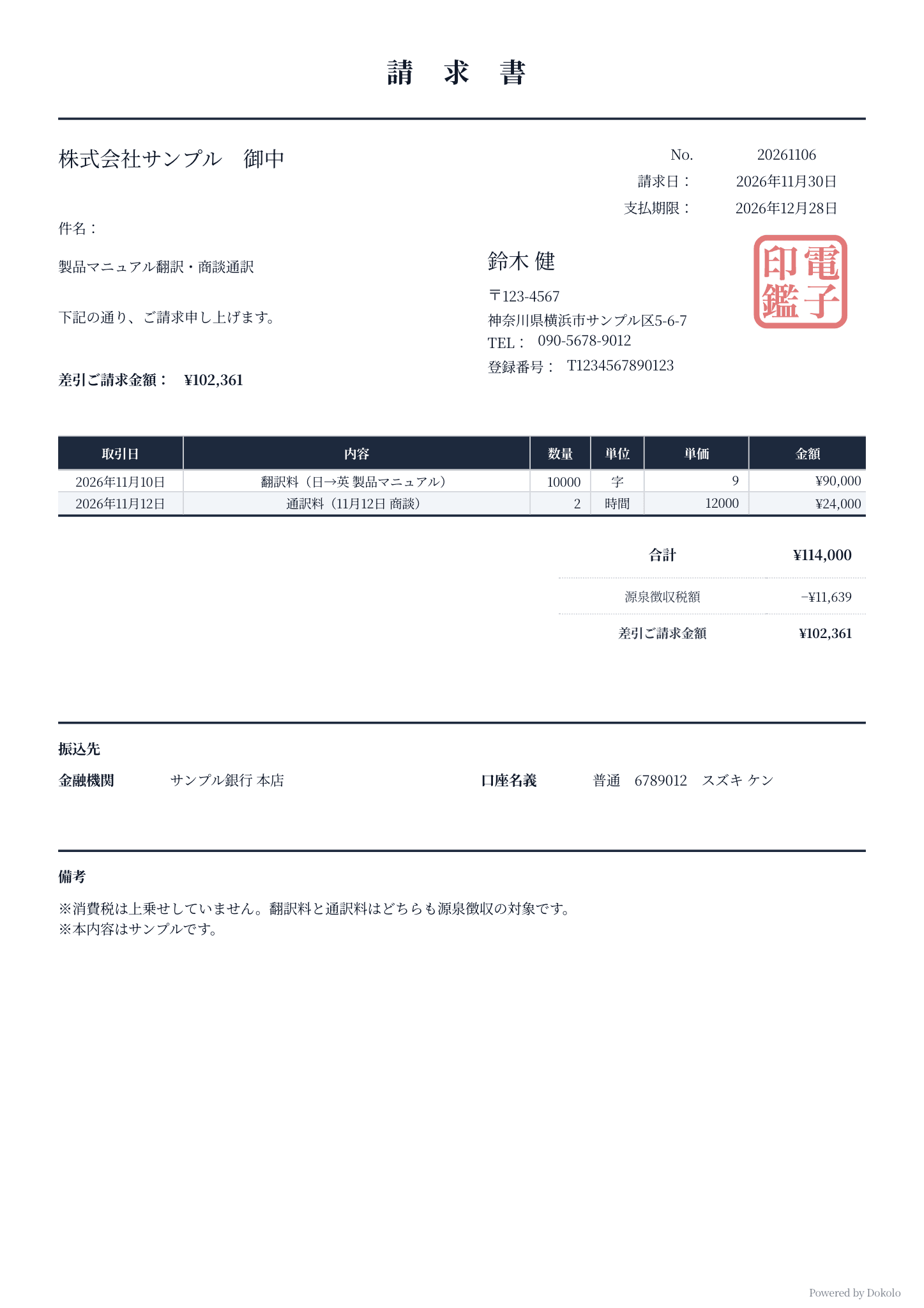
| Item | Amount | Calculation |
|---|---|---|
| 翻訳料(日→英 製品マニュアル 10,000字×9円) (translation) | ¥90,000 | |
| 通訳料(11月12日 商談 2時間×12,000円) (interpreting) | ¥24,000 | |
| 合計 (total) | ¥114,000 | 90,000 + 24,000 |
| 源泉徴収税額 (withholding tax) | −¥11,639 | 114,000 × 10.21% = 11,639.4, fraction dropped[3] |
| 差引ご請求金額 (net amount due) | ¥102,361 | 114,000 − 11,639 |
A rush surcharge is part of what you are paid for the translation, so it is included in the amount on which tax is withheld even if you list it separately[23]. How travel costs are treated is in the FAQ below.
If you are a Korean resident who is a non-resident for Japanese tax purposes and the client applies the 10% Japan–Korea treaty rate to a buy-out fee, label the line with the rate, such as 源泉徴収税額(租税条約 10%). On a ¥100,000 fee that is ¥10,000, leaving ¥90,000 due, assuming no consumption tax is added[7][19].
If you are resident in Japan and add consumption tax, withholding is in principle calculated on the amount including it. If the invoice clearly shows the fee and the tax separately, the client may withhold on the fee alone[3]. Worked examples are in Withholding Tax on Invoices in Japan, the withholding tax calculator gives the tax and net amount, and the other parts of the invoice are in How to Write an Invoice in Japan.
FAQ
Is tax withheld when I invoice a translation agency that is a company?
Yes. Withholding stops when the person receiving the fee is a Japanese corporation; a payer being a company does not stop it when the fee goes to an individual[18]. If you are an individual resident in Japan, an agency or company paying your translation fee withholds 10.21% of each payment up to ¥1,000,000 and 20.42% of any part above it[1][4][3]. If you contract and invoice through your own Japanese company, nothing is withheld[18]. A company whose head office is outside Japan is a foreign corporation for Japanese tax purposes and follows the foreign-company rules[1]; see Korea-to-Japan Withholding Tax.
Is tax withheld on travel costs I pay for an interpreting job?
In principle, yes. The NTA says payments of travel and accommodation costs are generally part of the fee[3]. They stay outside it only when the client pays the transport company or hotel directly and the amount is within what is normally needed[23]. For a Japan resident billing a ¥60,000 interpreting fee and ¥1,840 in train fares together, 10.21% of ¥61,840 is withheld: ¥6,313, with the fraction dropped. Put travel on its own line and check whether the client includes that line before you write the net amount.
Sources
- [1]
Income Tax Act, Articles 2, 161, 204 and 205 (e-Gov)
e-Gov Legal Search, current law (checked November 7, 2026)Primary source
- [2]
Order for Enforcement of the Income Tax Act, Article 320(1) (e-Gov)
e-Gov Legal Search, current law in force from May 22, 2026 (checked November 7, 2026)Primary source
- [3]
NTA No. 2795 — Payments for manuscripts, lectures and similar fees
Laws and related provisions as of April 1, 2026Primary source
- [4]
NTA No. 2502 — Who is a withholding agent?
Laws and related provisions as of April 1, 2026Primary source
- [5]
NTA No. 2793 — Withholding agents for fees and charges
Laws and related provisions as of April 1, 2026Primary source
- [6]
NTA interpretive Q&A — Translation fees paid to a non-resident
Laws, regulations and circulars as of August 1, 2025 (checked November 8, 2026)Primary source
- [7]
NTA No. 2884 — Withholding and tax rates for non-residents and foreign companies
Laws and related provisions as of April 1, 2026Primary source
- [8]
NTA No. 2888 — Filing the Application Form for Income Tax Convention (withholding tax)
Laws and related provisions as of April 1, 2026Primary source
- [9]
NTA interpretive Q&A — Fees for sign language interpreting
Laws, regulations and circulars as of August 1, 2025 (checked November 8, 2026)Primary source
- [10]
NTA interpretive Q&A — Fees for summary captioning (要約筆記)
Laws, regulations and circulars as of August 1, 2025 (checked November 8, 2026)Primary source
- [11]
NTA interpretive Q&A (withholding income tax) — Fees for checking a text (校閲)
Laws, regulations and circulars as of August 1, 2025 (checked November 8, 2026)Primary source
- [12]
freee tax accountant Q&A — Fees for proofreading a manuscript (answer by 竹市会計事務所, tax accountant)
Answered May 20, 2022 (practice; secondary source; checked November 8, 2026)
- [13]
Published August 10, 2024 (practice; secondary source; checked November 8, 2026)
- [14]
Answered September 26, 2026 (practice; secondary source; checked November 8, 2026)
- [15]
NTA No. 2878 — Scope of Japan-source income
Laws and related provisions as of April 1, 2026Primary source
- [16]
NTA Income Tax Basic Circulars 204-6 to 204-10 — Scope of manuscript and similar fees (Table 6)
Income Tax Basic Circular (checked November 7, 2026)Primary source
- [17]
NTA Outline of Withholding Tax 2026 (源泉徴収のあらまし), Chapter 5 — Withholding on fees and charges
Laws as of September 1, 2025 (checked November 8, 2026)Primary source
- [18]
NTA No. 2792 — Fees and charges subject to withholding
Laws and related provisions as of April 1, 2026Primary source
- [19]
Ministry of Finance — Japan–Republic of Korea tax treaty, Article 12: royalties
Checked November 8, 2026Primary source
- [20]
National Tax Tribunal ruling of December 11, 2009 — Case Reports No. 78, p. 208
Checked October 20, 2026Primary source
- [21]
NTA Q&A on consumption tax for cross-border services, Question 2-1
Revised June 2026Primary source
- [22]
NTA interpretive Q&A index — Withholding income tax (fees and charges; non-resident income)
Checked November 8, 2026Primary source
- [23]
Income Tax Basic Circular (checked November 7, 2026)Primary source
Last verified