

Invoicing as a Writer in Japan: Withholding on Manuscript Fees
For freelance writers, editors and copywriters billing Japanese clients: whether the client withholds income tax from your manuscript fee (原稿料), which kinds of writing work the law clearly covers, how practitioners treat the cases the law does not spell out (web articles, transcription), what changes if you are a non-resident for Japanese tax purposes, and how to lay out the invoice. Based on National Tax Agency (NTA), e-Gov and practitioner sources checked on November 7 and 8, 2026.
- Last verified
- 26 sources
- 17 min read
Who this is forIndividuals who write articles, columns, books or copy for Japanese publishers and companies as independent contractors, including people who write on the side of a salaried job. Most of the page assumes you are a tax resident of Japan; the first section covers what changes if you are a non-resident for Japanese tax purposes. Tax is not withheld from fees received through your own Japanese corporation, and invoicing as a company is not covered here.
Short answer
- If you are a tax resident of Japan, manuscript fees are named directly in Article 204(1)(i) of the Income Tax Act as subject to withholding tax (源泉徴収). A publisher or other corporation, or a sole proprietor who pays salaries (other than one whose only employees are two or fewer regular household workers), deducts 10.21% before paying you (20.42% on any part of a single payment above ¥1,000,000). An individual who pays no salaries does not withhold, and neither does a client paying your own Japanese corporation[1][2][3][4].
- If you are a non-resident for Japanese tax purposes, different rules apply. A fee only for writing done outside Japan may not be Japan-source income, while a payment for using or acquiring your copyright is in principle subject to withholding at a flat 20.42%, which a tax treaty may reduce[5][6].
- Proofreading, editorial review, supervision, advertising copy and remarks at a published round-table are also covered as manuscript-type fees. Setting exam questions and grading answers are not manuscript fees[7][8][9][10][11][2].
- For tax residents of Japan, fees for web and SEO articles are not addressed in the statute itself, but in practice they are generally treated as manuscript fees and withheld on. Plain transcription of recordings is not on the statutory list, and most tax accountants who have answered the question say it is not subject to withholding; it can be if you take it down with shorthand skills or the job includes rewriting or editing[1][12][13][14].
- Tax is withheld from a fee for writing you were commissioned to do even if the fee is ¥50,000 or less. The "under ¥50,000" relief applies only to things like contest prizes and payments for unsolicited reader submissions[1][8][2].
No sign-in needed to fill it in and download the PDF.
On this pageFirst: are you a resident of Japan for tax purposes?
First: are you a resident of Japan for tax purposes?
Japanese withholding tax works differently for tax residents (居住者) and non-residents of Japan. Residency here is a tax status, not your nationality. You are a resident if you have a domicile in Japan or have lived there continuously for a year or more; a non-resident for Japanese tax purposes has no domicile in Japan and no residence there for a year or more[1].
If you live in Japan
If you are a tax resident of Japan, the rules from "Which writing work is covered" onward apply to you. The client withholds 10.21% on each payment up to ¥1,000,000 and 20.42% on any part above it, with fractions of a yen dropped[1][2].
If you live outside Japan (e.g. Korea)
If you are a non-resident, the rules for non-residents apply, so do not use the table and the 10.21% rate below as they are. Pay for personal services is Japan-source income when it arises from services performed in Japan, so a fee only for writing you did outside Japan may not be Japan-source income[5]. But a royalty for, or payment for the transfer of, your copyright is Japan-source income when it is paid by a client doing business in Japan and connected with that business. The client then withholds 20.42% in principle, and a treaty can reduce the rate if you submit the Application Form for Income Tax Convention (租税条約に関する届出書) by the day before payment[5][6]. The NTA has published a case in which a translation commissioned from a resident of Korea on a buyout (買取り) basis was treated as payment for the transfer of rights in the work[15]. A manuscript contract that transfers your copyright to the client can raise the same question, so check the copyright clause with the client. For the tests and the treaty form, see Korea-to-Japan Withholding Tax, which explains the rules for people resident in Korea.
Which writing work is covered (tax residents of Japan)
Article 204(1)(i) of the Income Tax Act lists fees for manuscripts (原稿), and Article 320(1) of its Enforcement Order adds proofreading (校正), shorthand (速記), scripts and similar work[1][7]. The NTA says manuscript fees include scripts for plays, fees for spoken contributions, and fees for compiling or supervising books, but not fees for setting exam questions or grading answers[8][2]. Applied to the work writers usually take on, it looks like this.
| Work | Withholding |
|---|---|
| Articles and columns for magazines, newspapers and books, including interview and feature pieces | Yes. These are manuscript fees[1][16] |
| Web articles, SEO content and company blog posts | Generally yes, in practice. The law does not limit "manuscripts" to any medium, and tax accountants' answers and accountant-supervised guides do not distinguish print from web (this is practice, not an express NTA ruling). See "Web articles are treated as manuscripts" below[1][12][13] |
| Advertising copy | Yes. The NTA has treated the copy for an advertising poster as a manuscript fee[10] |
| Proofreading (checking for typos and style) | Yes. The Enforcement Order lists proofreading, and the NTA's guide gives proofreading of books and magazines as the example[7][16] |
| Editorial review (校閲), supervision and compiling books | Yes. Compiling and supervision fees are manuscript fees, and the NTA treated a fee for reviewing a written summary of a lecture as "a kind of supervision fee"[8][9] |
| Speaking at a round-table published in a newspaper or magazine | Yes. Remarks at the round-table are treated like a written manuscript, as a fee for a spoken contribution (口述)[8][11] |
| Scripts for plays and other performances | Yes[8][7] |
| Setting exam questions, grading answers, judging contest entries | Not manuscript fees[8][2] |
| Transcription (turning recordings into text, 文字起こし) | Plain transcription (素起こし): most tax accountants' answers say no. It can be covered as shorthand (速記) if you use shorthand skills, or as a manuscript fee if the job includes cleaning up, rewriting, editing or supervision. See below the table[7][14][17] |
| Book royalties (印税) | Covered as copyright royalties rather than manuscript fees (see "Book royalties" below)[16] |
Transcription: the statute does not mention it, but most tax accountants who have answered the question say plain transcription of recordings (素起こし) needs no withholding, because it is not among the fees the law lists[14][18]. The NTA has also said that summary captioning (要約筆記), where speech is summarized and shown as text for people with hearing loss, is neither interpreting nor shorthand (different work from transcription)[19]. On the other hand, taking a recording down with shorthand skills is a shorthand fee under the Enforcement Order[7][17], and a job called transcription that also includes cleaning up, rewriting, editing or supervision can be a manuscript fee[14]; both are subject to withholding.
In practice some clients deduct 10.21% even from plain transcription[18]. But your Japanese final tax return (確定申告) credits only tax that was correctly withheld under the law. An amount deducted when no withholding was required cannot be recovered through the return; you have to claim it from the client directly[20]. So for plain transcription, tell the client your basis before you invoice and agree that nothing will be withheld.
A message in Japanese telling the client you will bill plain transcription without withholding (says the work is transcription only and asks them to say before you invoice if they treat it differently)
今回の文字起こし(録音の書き起こしのみで、リライト・編集は含みません)の報酬は、所得税法で源泉徴収の対象として列挙された報酬に当たらないと考えておりますので、源泉徴収税額を差し引かない金額で請求書を作成いたします。御社で異なる扱いをされる場合は、請求書の作成前にお知らせいただけますでしょうか。
Even for the "Yes" rows, nothing is withheld if the client is not a withholding agent; the section on clients below explains who is.
Web articles are treated as manuscripts: practice and the exceptions
How practice treats them: for tax residents of Japan, fees for web articles, SEO content and blog posts are generally treated as manuscript fees and withheld on. A guide from the accounting software company Yayoi, supervised by a tax accountant, says the pay of web writers who write text for web pages counts as a manuscript fee[12], and a tax accountant answering a web writer says manuscript fees are, as a rule, withheld on[13]. This is practitioners' reading rather than an express NTA ruling, but it fits the wording of the law.
What the law says: Article 204(1)(i) refers simply to fees for manuscripts and does not limit them to print or any other medium[1]. Photographs are different: Article 320(1) of the Enforcement Order covers only photos "for publication in magazines, advertisements or other printed matter"[7], while manuscripts carry no such limit. None of the NTA materials checked (Basic Circulars 204-6 to 204-10, the 16 withholding Q&A cases on fees and charges, and Tax Answer No. 2795) names web articles[8][2], and the case treating copywriting as a manuscript fee, which gives publication in "publications and the like" (出版物等) as the reason, does not say whether online publication is included[10].
When nothing is withheld: this turns on who the parties are, not on whether the piece is online. An individual client who pays no salaries, such as a solo blogger, is not a withholding agent, and nothing is withheld when you are paid through your own Japanese corporation[1][3][4]. On some Japanese crowdsourcing platforms the client chooses on the job form whether to withhold, and the platform states that the duty to withhold on covered work is the client's[21]. That is why the same kind of web article job is withheld on by some clients and not by others.
Your invoice: for a corporate client, show the withholding tax and the net amount due, as for a print article. If the client does not withhold, see the FAQ "My client paid the full fee without withholding anything" below. If you are a non-resident, follow the first section.
A note in Japanese to add when you bill a web article fee net of withholding (says web article fees are generally treated as manuscript fees and asks the client to say if it treats them differently)
Web記事の原稿料も「原稿の報酬」として源泉徴収の対象と扱われるのが一般的なため、源泉徴収税額を差し引いた差引ご請求金額で請求書を作成いたします。御社で異なる扱いをされている場合はお知らせいただけますでしょうか。
Small fees are not exempt: commissioned writing has no minimum
Under Article 205(i) of the Income Tax Act, withholding on a manuscript fee is the payment multiplied by the rate. The rule that subtracts a fixed amount first (Article 205(ii)) does not apply to manuscript fees[1]. Even a fee of a few thousand yen for a short piece is subject to withholding if the client is a withholding agent.
| Fee | Withholding tax | Net amount due |
|---|---|---|
| ¥8,000 | ¥816 | ¥7,184 |
| ¥50,000 | ¥5,105 | ¥44,895 |
The ¥50,000 figure comes from two other rules. Neither one lets the client skip withholding on a piece it asked you to write.
- Contest prizes and reader submissions: tax need not be withheld on prizes for contest winners or payments for submissions to a newspaper or magazine reader column when a single payment is roughly ¥50,000 or less. Payments to people who were asked in advance to contribute are excluded from this relief[8][2].
- Payment statement threshold: the client files a payment statement (支払調書) with its tax office by January 31 following the year in which the payment was fixed, for manuscript fees paid to one writer totaling more than ¥50,000 in the year. This is a reporting test, separate from withholding[22].
Clients who withhold and clients who do not: invoice them separately
Whether tax is withheld from the same fee depends on who pays it. Before you draft the invoice, check which of these your client is.
| Who pays / how you are paid | Withholding | On your invoice |
|---|---|---|
| A publisher, newspaper, production company or other corporation, or a government office | Yes[1][3] | Show the withholding tax and the net amount due |
| A sole proprietor who pays salaries to staff or to a family member (青色事業専従者), such as a one-person editorial studio | Yes[23] | Show the withholding tax and the net amount due |
| An individual who pays no salaries, such as a person running their own blog or site, or whose only employees are two or fewer regular household workers | No[1][3][23] | Bill the fee in full, with no withholding line |
| You receive the fee through your own company (a Japanese domestic corporation) | No[4] | Bill in the company's name, with no withholding line |
| You are employed by the publisher and paid a salary | The fee rules on this page do not apply; the payment is treated as salary[1] | — |
If you bill both kinds of client in the same month, make a separate invoice for each client and put the withholding line only on invoices to clients who withhold. Reusing one template for everyone is how a client who does not withhold ends up billed a net amount. If an individual hires you, ask whether they pay any salaries before you draft the invoice. How payers are classified is explained in more detail in Withholding Tax on Invoices in Japan.
This page assumes the client pays you directly. For work taken through a crowdsourcing platform, check how withholding is handled in that platform's terms and the conditions of the job.
Writing the invoice: line items and research costs
Japanese clients' accounting staff check invoices in Japanese, so Japanese line descriptions help. Say which publication and which piece each line is for, and add the number of pieces or the word or character count when you are paid per piece or per character, so the client can match the invoice to the order.
- 原稿料(機内誌『○○』英語記事 2本) — manuscript fee, two English articles for an in-flight magazine
- 校正料(同誌 英文校正) — proofreading fee, English proofreading for the same magazine
- 取材費(実費・交通費) — research costs, actual travel expenses
Tax is withheld from research or investigation costs when they are in substance part of the manuscript fee. Travel and hotel costs for your research that you pay yourself and bill to the client are in principle included too. They stay outside only when the client pays the transport company or hotel directly and the amount is within what is normally needed[2]. The example below assumes a tax resident of Japan who does not add consumption tax.
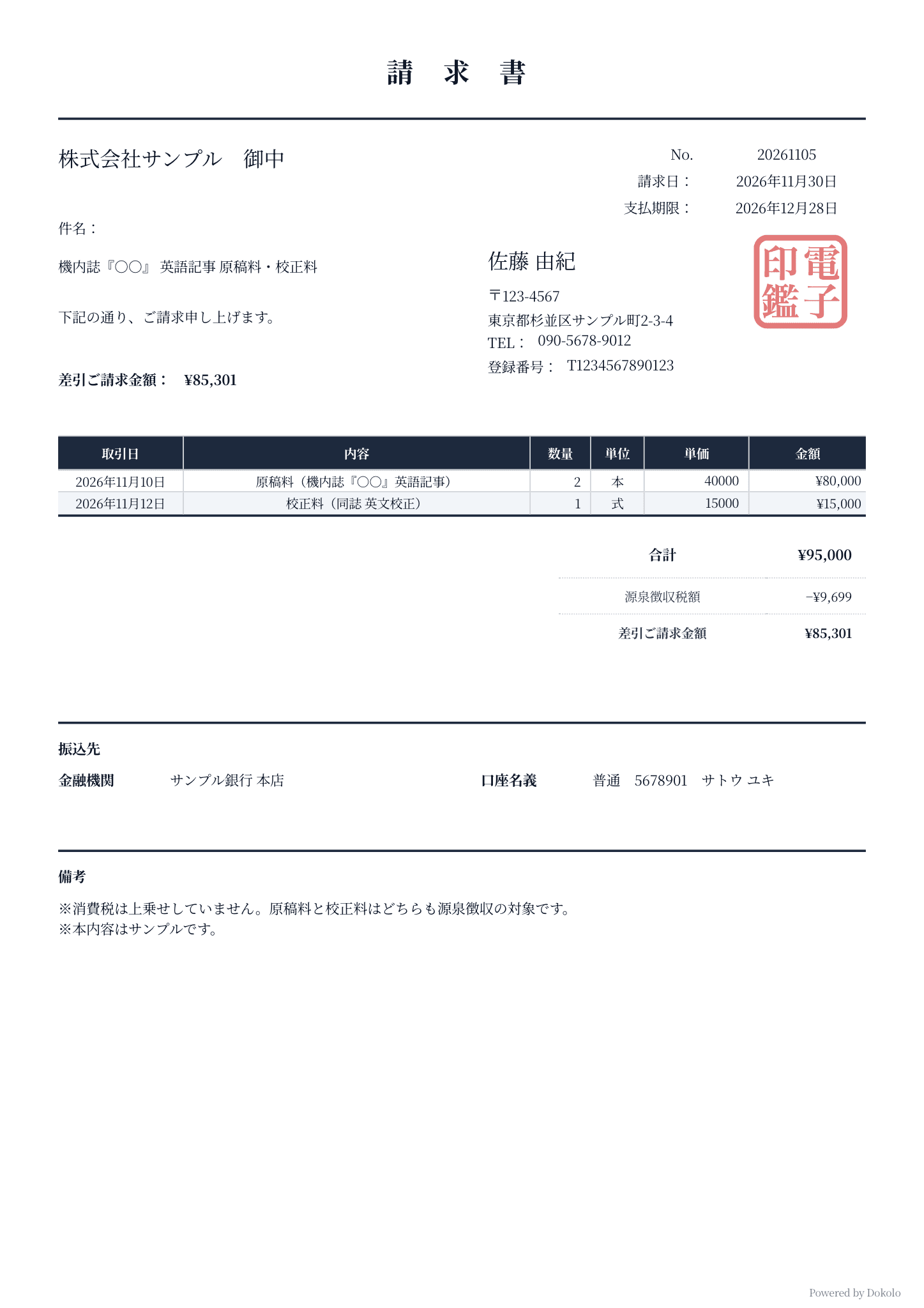
| Line | Amount | Calculation |
|---|---|---|
| 原稿料(機内誌『○○』英語記事 2本) — Manuscript fee | ¥80,000 | 2 × ¥40,000 |
| 校正料(同誌 英文校正) — Proofreading fee | ¥15,000 | |
| 合計 — Total | ¥95,000 | ¥80,000 + ¥15,000 |
| 源泉徴収税額 — Withholding tax | −¥9,699 | ¥95,000 × 10.21% = ¥9,699.50, fraction dropped[2] |
| 差引ご請求金額 — Net amount due | ¥85,301 | ¥95,000 − ¥9,699 |
If an individual who pays no salaries commissions the same articles, leave out the withholding line and bill the fee in full. See How to Write an Invoice in Japan for the other items on an invoice.
Book royalties are copyright royalties
The NTA's withholding guide classifies book royalties (書籍の印税) as copyright royalties rather than manuscript fees. Both fall under Article 204(1)(i), so for a tax resident of Japan the calculation is the same: 10.21% on each payment up to ¥1,000,000 and 20.42% above it[16][1]. If a book contract pays you both a manuscript fee and royalties, keep them on separate lines so you can later tell which payment was which. For non-residents, royalties follow the copyright rules in the first section.
FAQ
Can I get a 源泉徴収票 (withholding slip) for my manuscript fees?
A 源泉徴収票 is the slip for salary, retirement allowances and public pensions. For manuscript fees paid to a tax resident of Japan, what the client prepares is a statement of payments of fees, charges, contract money and prizes (報酬、料金、契約金及び賞金の支払調書)[24]. The client files it with its tax office by January 31 following the year in which the payment was fixed, when its payments to you in the year total more than ¥50,000[22][24]. Payments to non-residents can fall under a different statement and threshold[22]. The NTA says a copy given to the recipient must not show anyone's My Number, but the materials checked do not say the client has to give you a copy, so you may not receive one[22]. If you are a tax resident of Japan, the tax withheld is settled on your final tax return (確定申告)[25], so total your fees and the tax withheld each year from your invoices, the client's payment notices and your bank records.
If I add consumption tax, is tax withheld from the consumption tax too?
If the invoice shows the fee and the consumption tax separately, the client may withhold on the fee alone. If you show only a tax-inclusive total, the consumption tax is included in the base. This holds even if your invoice is not a qualified invoice[2][26]. For example, a ¥30,000 fee shown with ¥3,000 consumption tax gives ¥3,063 withholding; a single tax-inclusive ¥33,000 gives ¥3,369. Try your own numbers in the withholding tax calculator, and see Withholding Tax on Invoices in Japan for a worked example.
My client paid the full fee without withholding anything. Is that a problem?
If the client is an individual who pays no salaries, not withholding is the normal rule[1][3]. If the client is a corporation and the work is clearly covered, such as a print article or proofreading, the duty to withhold is the client's, so ask the client about it[1][23]. Web articles are generally treated as manuscript fees in practice[12][13], so ask a corporate client in the same way. On Japanese crowdsourcing platforms, the client may have set the job form not to withhold[21]. Withholding and paying the tax is the client's duty, so if the client has decided not to withhold, invoice that way. If you are a non-resident, a fee only for work done outside Japan may not be subject to Japanese withholding; follow the first section[5].
Sources
- [1]
Income Tax Act, Articles 2, 204 and 205 (e-Gov)
e-Gov Legal Search, current law (checked November 7, 2026)Primary source
- [2]
NTA No. 2795 — Payments for manuscripts, lectures and similar fees
Laws and related provisions as of April 1, 2026 (checked November 8, 2026)Primary source
- [3]
NTA No. 2502 — Who is a withholding agent?
Laws and related provisions as of April 1, 2026Primary source
- [4]
NTA No. 2792 — Fees and charges subject to withholding
Laws and related provisions as of April 1, 2026Primary source
- [5]
NTA No. 2878 — Scope of Japan-source income
Laws and related provisions as of April 1, 2026Primary source
- [6]
NTA No. 2884 — Withholding and tax rates for non-residents and foreign companies
Laws and related provisions as of April 1, 2026Primary source
- [7]
Order for Enforcement of the Income Tax Act, Article 320(1) (e-Gov)
e-Gov Legal Search, current law in force from May 22, 2026 (checked November 7, 2026)Primary source
- [8]
Income Tax Basic Circular (checked November 7, 2026)Primary source
- [9]
NTA interpretive Q&A — Fees for reviewing a text (校閲)
Laws, regulations and circulars as of August 1, 2025 (checked November 8, 2026)Primary source
- [10]
NTA interpretive Q&A — Fees paid to copywriters, illustrators and lettering artists
Laws, regulations and circulars as of August 1, 2025 (checked November 8, 2026)Primary source
- [11]
NTA interpretive Q&A — Fees for a round-table discussion to be published in a newspaper
Laws, regulations and circulars as of August 1, 2025 (checked November 8, 2026)Primary source
- [12]
Updated August 22, 2024 (practice; secondary source; checked November 8, 2026)
- [13]
Zeirishi.com tax Q&A — Withholding for a freelance writer (answer by tax accountant 小川真文)
Answered November 26, 2023 (practice; secondary source; checked November 8, 2026)
- [14]
Zeirishi.com tax Q&A — Is transcription alone outside withholding? (answer by tax accountant 實森順平)
Answered February 3, 2020 (practice; secondary source; checked November 8, 2026)
- [15]
NTA interpretive Q&A — Translation fees paid to a non-resident
Laws, regulations and circulars as of August 1, 2025Primary source
- [16]
NTA, Outline of Withholding Tax 2026 (源泉徴収のあらまし), Chapter 5 — Withholding on fees and charges (PDF)
Laws as of September 1, 2025 (checked November 7, 2026)Primary source
- [17]
Blog of a former NTA withholding specialist — Shorthand fees for transcribing recorder playback
Published September 22, 2021 (practice; secondary source; checked November 8, 2026)
- [18]
Yayoi tax accountant Q&A — On withholding (answer by tax accountant 吉田均)
Answered March 19, 2025 (practice; secondary source; checked November 8, 2026)
- [19]
NTA interpretive Q&A — Fees for summary captioning (要約筆記)
Laws, regulations and circulars as of August 1, 2025 (checked November 8, 2026)Primary source
- [20]
National Tax Tribunal ruling of November 27, 2006 — Case Reports No. 72, p. 246
Checked November 8, 2026Primary source
- [21]
Lancers Help — Conditions for jobs subject to withholding
No publication date shown (platform rules; secondary source; checked November 8, 2026)
- [22]
Laws and related provisions as of April 1, 2026 (checked November 8, 2026)Primary source
- [23]
NTA No. 2793 — Withholding agents for fees and charges
Laws and related provisions as of April 1, 2026Primary source
- [24]
Laws as of September 1, 2025 (checked November 7, 2026)Primary source
- [25]
NTA No. 2020 — Final income tax returns
Laws and related provisions as of April 1, 2026Primary source
- [26]
NTA — Withholding on fees and charges after the invoice system begins
Published December 9, 2021 (checked November 7, 2026)Primary source
Last verified