

Invoicing for Lectures and Teaching in Japan: Fees, Travel Costs and Withholding
For freelance teachers, trainers and speakers billing Japanese clients: whether the client withholds income tax from your fee, what changes if you are a non-resident for Japanese tax purposes, why a fee under ¥50,000 is still subject to withholding, and how to list travel costs on the invoice. Based on National Tax Agency (NTA) and e-Gov sources checked on November 7, 2026.
- Last verified
- 17 sources
- 10 min read
Who this is forIndividuals who teach, train or give talks for Japanese clients as independent contractors, such as English teachers giving lessons or corporate training, workshop instructors and speakers. Most of the page assumes you are a tax resident of Japan; the first box covers what changes if you are a non-resident for Japanese tax purposes. Fees received through your own Japanese corporation are not withheld on, and invoicing as a company is not covered here.
Short answer
- If you are a tax resident of Japan, fees for lectures and for teaching, including language lessons, are subject to withholding tax (源泉徴収). A company, school or other organization, or a sole proprietor who pays salaries, deducts 10.21% before paying you (20.42% on any part of a single payment above ¥1,000,000). Calling the payment an honorarium (謝礼) or "travel money" (お車代) does not change this[1][2][3][4].
- If you are a non-resident for Japanese tax purposes and come to Japan to teach or speak, non-resident rules apply: generally a flat 20.42%, which a tax treaty may reduce or remove[5][6].
- Lecture and teaching fees have no minimum amount for withholding. A ¥24,000 lesson fee paid by a company still has ¥2,450 withheld. The ¥50,000 figure people mention is the threshold for the payment statement (支払調書) the client files, not a withholding threshold[1][7].
- Travel and hotel costs you pay yourself and bill to the client are in principle part of the fee subject to withholding. They stay outside it only when the client pays the transport company or hotel directly and the amount is within what is normally needed[4][8].
No sign-in needed to fill it in and download the PDF.
On this pageWhen a teaching or lecture fee is subject to withholding
When a teaching or lecture fee is subject to withholding
If you live in Japan
For tax residents of Japan, lecture and teaching fees are subject to withholding at 10.21% on each payment up to ¥1,000,000 and 20.42% on any part above it, with fractions of a yen dropped[1][4]. The rest of this page assumes this case.
If you live outside Japan (e.g. Korea)
Non-residents for Japanese tax purposes (no domicile in Japan and no residence there for a year or more) follow different rules[1]. Pay for personal services is Japan-source income when it arises from services performed in Japan[5]. If you come to Japan to teach or give a talk, the client generally withholds a flat 20.42% from an individual's fee, with no ¥1,000,000 tier, unless a tax treaty reduces or removes it[6]. Online lessons taught from outside Japan are assessed differently; see Korea-to-Japan Withholding Tax, which explains the rules for people resident in Korea.
Article 204(1)(i) of Japan's Income Tax Act lists lecture fees (講演料), and Article 320(1) of its Enforcement Order adds fees for teaching or coaching arts, sports and similar skills, and for teaching knowledge[1][2]. The NTA's basic circular gives examples, and language teaching (語学) is named explicitly, alongside cooking, dance, calligraphy and instructor fees for qualification courses[3]. English lessons and English training sessions therefore fall in this category.
Whether tax is actually withheld depends on who pays you and how. The table assumes you are a tax resident of Japan.
| Who pays / how you are paid | Withholding |
|---|---|
| A company (for example, in-house English training), a language school or other corporation, or a government office | Yes[1][9] |
| A sole proprietor who pays salaries to staff or to a family member (青色事業専従者), such as an individual running a small school | Yes[10] |
| An individual who pays no salaries, such as a private student paying for their own lessons | No[1][9] |
| You receive the fee through your own company (a Japanese domestic corporation) | No[11] |
| You are an employee of the school and are paid a salary | The fee rules on this page do not apply; the payment is treated as salary[1] |
If an individual hires you, ask whether they pay any salaries before you draft the invoice, so you show the right net amount. The full list of covered fees and how payers are classified is in Withholding Tax on Invoices in Japan.
Small fees are not exempt: ¥50,000 is a reporting threshold
Under Article 205(i) of the Income Tax Act, withholding on lecture and teaching fees is the payment multiplied by the rate. The rule that subtracts a fixed amount first (Article 205(ii)) covers other fees, such as those of judicial scriveners, not these[1]. The NTA's rate table shows "A × 10.21%" for payments up to ¥1,000,000, with no minimum[4].
| Fee | Withholding tax | Net amount due |
|---|---|---|
| ¥24,000 (4 lessons × ¥6,000) | ¥2,450 | ¥21,550 |
| ¥50,000 | ¥5,105 | ¥44,895 |
The ¥50,000 figure comes from two other rules. Neither one lets the client skip withholding on a fee for lessons or a talk it asked you to give.
- Payment statement threshold: the client files a "statement of payments of fees, charges, contract money and prizes" (支払調書) with its tax office by January 31 of the following year for lecture fees and similar payments to one person totaling more than ¥50,000 in the year. The NTA says the statement is required even for fees from which nothing was withheld, so it is a separate test[7].
- Small prizes and reader submissions: tax need not be withheld on prize money for contest winners and small payments for unsolicited reader submissions to newspapers or magazines when a single payment is roughly ¥50,000 or less. Payments to people who were asked in advance to contribute are excluded, and lecture fees are not part of this rule[3][4].
Travel and hotel costs: who pays whom determines the amount subject to withholding
The NTA states that travel and hotel costs are in principle included in the fee subject to withholding[4]. If you buy the train ticket or pay the hotel yourself and add it to your invoice, tax is withheld from that amount too. Cash handed to you on the day as "travel money" (お車代) is also covered when it is really part of the fee, whatever it is called[8][4].
The exception is Basic Circular 204-4. The client need not withhold on travel and hotel costs that meet all three of these conditions[8]:
- The client bears the travel or accommodation cost of your trip to provide the service
- The money is paid by the client directly to the transport company, hotel, inn or similar, not given to you
- The amount is within what is normally needed for that cost
| How the cost is paid | On your invoice | Subject to withholding |
|---|---|---|
| You book and pay, then bill the client | A separate line, such as 交通費(実費) (travel, actual cost) | Yes, in principle[4] |
| The client books and pays the transport company or hotel directly | Nothing (you have no cost to bill) | No, if within the normal range[8] |
| The client hands you cash as "travel money" on the day | A line on the invoice if you bill it together with your fee | Yes, in principle[8][4] |
The duty to withhold is the client's[1]. If you list travel costs, confirm beforehand whether the client will withhold on that line too, and make your net amount match its calculation.
Writing the invoice: separate the fee from expenses
Use a subject line that says which sessions you are billing for, such as 「英会話研修 講師料(2026年11月分)」 (English training fee, November 2026). Japanese clients' accounting staff check invoices in Japanese, so Japanese line descriptions help. Put the teaching fee and each expense on separate lines, and mark expenses as 実費 (actual cost). The example below assumes a tax resident of Japan who does not add consumption tax and paid the train fares to the client's office.
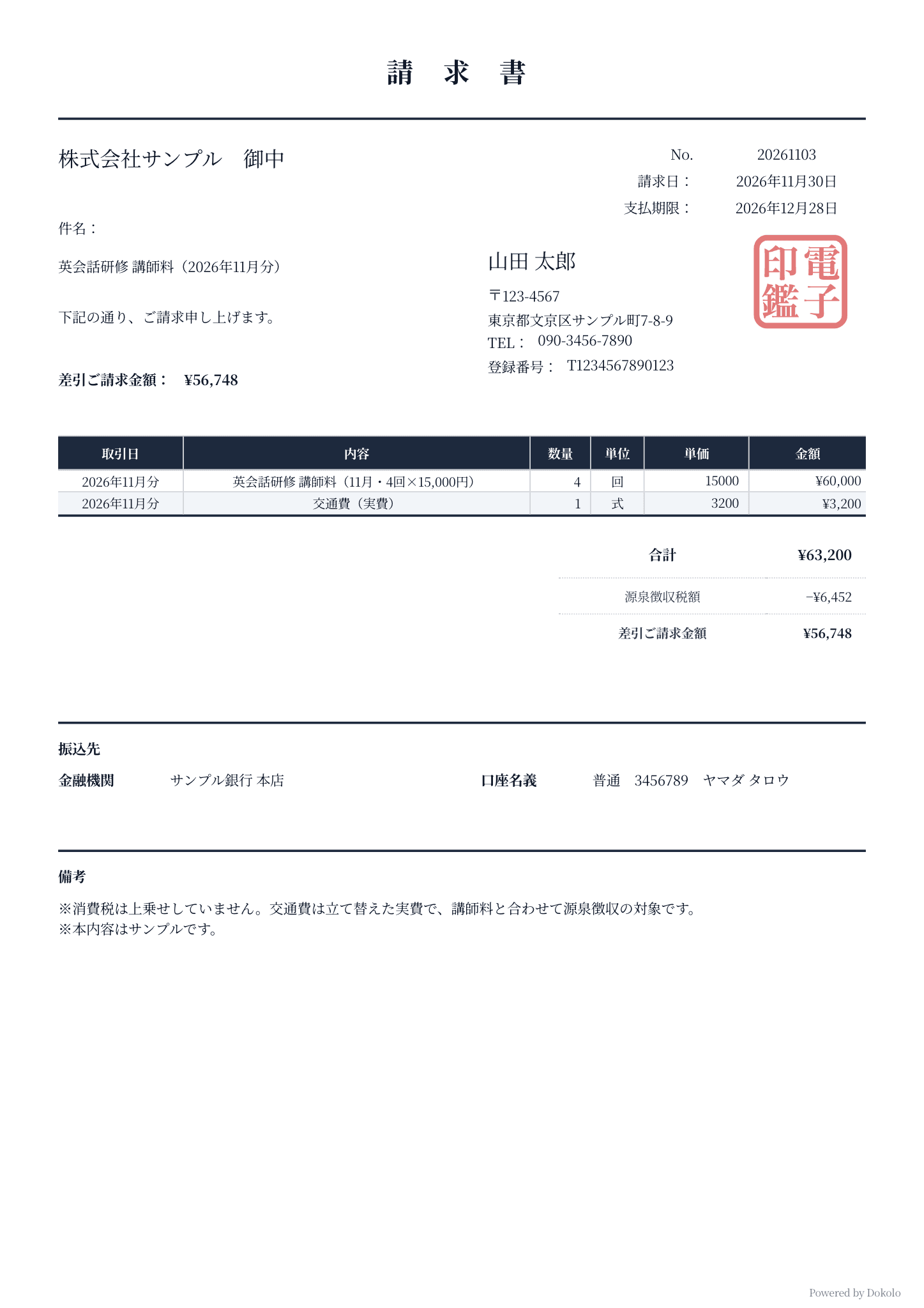
| Line | Amount | Calculation |
|---|---|---|
| 英会話研修 講師料(11月・4回×15,000円) — English training fee | ¥60,000 | 4 × ¥15,000 |
| 交通費(実費) — Train fares, actual cost | ¥3,200 | |
| 合計 — Total | ¥63,200 | ¥60,000 + ¥3,200 |
| 源泉徴収税額 — Withholding tax | −¥6,452 | ¥63,200 × 10.21% = ¥6,452.72, fraction dropped[4] |
| 差引ご請求金額 — Net amount due | ¥56,748 | ¥63,200 − ¥6,452 |
If you add consumption tax, show the fee and the tax separately; the client may then withhold on the fee alone. Otherwise the tax-inclusive amount is the base[4][12]. See Withholding Tax on Invoices in Japan for a worked example, and How to Write an Invoice in Japan for the other items on an invoice.
If you also have a salaried job in Japan
Many teachers combine a salaried job with freelance lessons or talks. The freelance fees are invoiced, and tax is withheld from them as described above; your employment does not change that[1][9].
If you receive salary from one employer, all of it subject to withholding, you must file a final tax return (確定申告) when your income other than salary and retirement income totals more than ¥200,000, unless filing would result in a refund[13]. When you file, the tax withheld from your fees is settled against the tax you owe[14]. Keep your invoices and bank records by year so you can total what was withheld.
FAQ
Is tax withheld if I am paid an honorarium or given a gift instead of a fee?
Money paid for your talk or lesson is covered even when it is called an honorarium, travel money or a gift allowance[8]. If you receive goods rather than money, their value is assessed, and tax need not be withheld on small amounts. The circular does not say what counts as small, so ask the client. This small-amount rule does not cover someone who works exclusively for one client: benefits they receive follow the rules for non-cash salary benefits[8]. If the client calls the payment an honorarium (謝礼), you can use 講演謝礼 as the line description; the name does not change how withholding works.
Do I need an invoice registration number on my teaching invoice?
Only businesses registered as qualified invoice issuers (適格請求書発行事業者) can show a registration number. If you are not registered, leave it off, and do not use someone else's number or anything that looks like one[15][16]. An invoice without a registration number is not a qualified invoice, but you can still send it to request payment[17]. Withholding works the same either way[12]. To decide whether to register, see Japan’s Qualified Invoice System.
Sources
- [1]
Income Tax Act, Articles 2, 204 and 205 (e-Gov)
e-Gov Legal Search, current law (checked November 7, 2026)Primary source
- [2]
Order for Enforcement of the Income Tax Act, Article 320(1) (e-Gov)
e-Gov Legal Search, current law in force from May 22, 2026 (checked November 7, 2026)Primary source
- [3]
Income Tax Basic Circular (checked November 7, 2026)Primary source
- [4]
NTA No. 2795 — Payments for manuscripts, lectures and similar fees
Laws and related provisions as of April 1, 2026Primary source
- [5]
NTA No. 2878 — Scope of Japan-source income
Laws and related provisions as of April 1, 2026Primary source
- [6]
NTA No. 2884 — Withholding and tax rates for non-residents and foreign companies
Laws and related provisions as of April 1, 2026Primary source
- [7]
Laws and related provisions as of April 1, 2026Primary source
- [8]
Income Tax Basic Circular (checked November 7, 2026)Primary source
- [9]
NTA No. 2502 — Who is a withholding agent?
Laws and related provisions as of April 1, 2026Primary source
- [10]
NTA No. 2793 — Withholding agents for fees and charges
Laws and related provisions as of April 1, 2026Primary source
- [11]
NTA No. 2792 — Fees and charges subject to withholding
Laws and related provisions as of April 1, 2026Primary source
- [12]
NTA — Withholding on fees and charges after the invoice system begins
Published December 9, 2021 (checked November 7, 2026)Primary source
- [13]
NTA No. 1900 — Salaried employees who must file a final tax return
Laws and related provisions as of April 1, 2026Primary source
- [14]
NTA No. 2020 — Final income tax returns
Laws and related provisions as of April 1, 2026Primary source
- [15]
NTA No. 6498 — Overview of the qualified invoice-based method (invoice system)
Laws and related provisions as of April 1, 2026Primary source
- [16]
NTA Invoice System Q&A, Q26-2 — Markings that could be mistaken for qualified invoices
Revised April 2026Primary source
- [17]
NTA Invoice System Q&A, Q54 — Documents without a registration number and segmented-entry invoices
Revised April 2024Primary source
Last verified